Oh, I come from a long line of worriers!
I’ve always been a worrier.
If I didn’t worry, then I’d worry about not being worried.
These are just some of the phrases I hear from clients when they speak about worrying.
We can all worry from time-to-time. But what-if worriers or people who have generalised anxiety disorder tend to have a frequent or constant feeling of anxiety and dread and can worry disproportionately about everyday things.
The subject of the worry tends to change e.g., worrying about health for a while, then worrying about finances, then worrying about career and so on.
What-if worriers worry about possible outcomes, regardless of how likely or unlikely it is that the worry would happen:
- What if it rains? What if it turns cold? What if I’m too hot?
- What if I get ill? What if I can’t go to work? What if I can’t pay the bills?
- What if I say something wrong? What if they don’t invite me back? What if I end up alone?
- What if I have a panic attack? What if I can’t cope? What if I’m always like this?
- What if I fail? What if I never progress? What if I’m stuck?
People who aren’t consumed by these worries might view the what-if worrier as irrational, or have a hard time empathising with them; they’ll simply think ‘well that won’t happen’, and move on with their day.
But for the what-if worrier, it can be exhausting and debilitating to consider possible outcomes, try to plan accordingly, and make appropriate decisions.
The symptoms of this type of worry can vary from person to person but can include:
- Having worries that are catastrophic in nature.
- Difficulty controlling worries.
- Knowing the worry is disproportionate but not feeling able to let it go.
- Feeling restless and having trouble relaxing.
- Difficulty concentrating.
- Trouble falling asleep or staying asleep.
- Lethargy or exhaustion.
- Headaches, muscle aches, stomach aches, or other unexplained pains.
- Irritability or feeling on edge.
- Over-preparation, procrastination, total avoidance.
With what-if worries, we don’t need to go down the rabbit hole of discussing each worry in detail; even if we solve a worry, there’ll always be another one coming down the tracks.
Instead, it can be more helpful to consider what purpose the worrying is serving in your life and then take steps to consider the benefits and costs of living in this way.
The 5 most common internalised reasons for worrying are:
- To be prepared. If I worry about the worst, then I’ll be prepared.
- It’s viewed a positive personality trait. If I worry, then I’ll come across well.
- To prevent negative emotions. If I worry, then I won’t feel disappointed when the worst happens.
- To prevent negative outcomes. If I worry, then things won’t go wrong.
- To help with problem solving. If I worry, then I’ll solve the problem.
Underlying each of these reasons, is an intolerance of uncertainty and a need to find control.
Once you’ve established your reason, you can write out the benefits and costs.
A short example: If I worry about the worst, then I’ll be prepared.
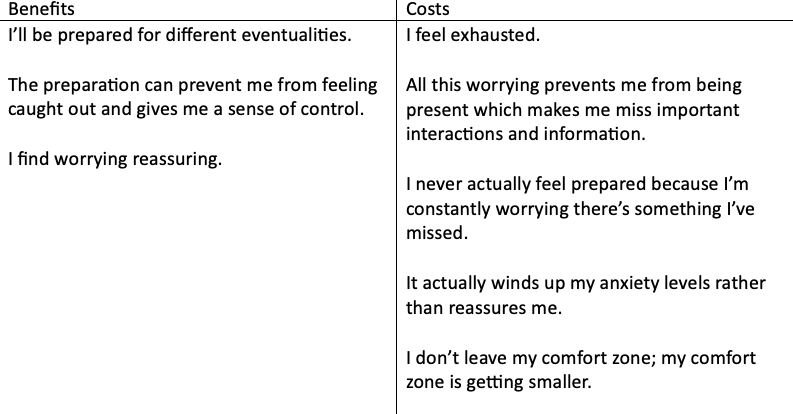
Write down all your benefits and costs and consider if you were to put the lists on a set of scales, which list weighs the most?
Now we need to challenge the worry.
Each of the following steps can seem tricky, but try to be firm with yourself, you can do it!
- Acknowledge that you’re worried and remind yourself that you’re in the habit of worrying when it’s not necessary so it’s likely that this is another example.
- Establish if the worry is real or hypothetical.
Take your worry to court! What’s the evidence for and against this worry? Let the judge decide if it’s a real worry that’s worthy of your time and effort.
If it’s a sunny day, worrying about being caught in the rain is a hypothetical worry because the evidence is that the sun is shining.
If you’ve got a cough, worrying about it being a sign of a serious illness is hypothetical because the evidence is that coughs and colds are common (do get it checked if it’s been with you for longer than 3 weeks). - If it’s hypothetical, change your attention to let the worry go.
Read a book, do some exercise, talk to a friend about something unrelated.
The brain will likely still want you to worry but keep guiding it back to the activity you’re doing. - If it’s real, make a plan then let the worry go.
Once you have your plan in place, you can feel safe in the knowledge that you really are prepared then change your attention by doing something you enjoy.
If you have a presentation at work or at university that you’re worrying about, take action. Make sure you have what you need to present e.g., presentation slides and your script. Look out the clothes you’re going to wear. Consider your transport to the event.
With worrying, we want to control the controllables and let go of the rest. This tends to be easier said than done but consistent practice will go a long way!
Remember, worrying is normal and natural and impossible to stop completely.
The purpose is not to stop you from worrying, it’s about being able to manage and cope with worries and self-soothe.
A therapist can help you work through this if you’re still struggling.
 Therapy with Kirsty