Categories
Uncategorized

Can you tell me you feel like sh*t?

YES!

I have no problem with you swearing in therapy sessions, as long as it’s not at me of course.

However, being able to name emotions is one of the first steps to regulating and processing.

So, you can tell me you feel like sh*t and I’ll probably say something like:

  • What does feeling sh*t mean for you right now? 
    (Sh*t can mean tired, sad, guilty, I can’t assume I know what you mean)
  • Where do you notice this feeling in your body?
    (Heavy eyes, knot in stomach, tight chest)
  • What would this sensation say if it had a voice?
    (I need rest, my feelings are hurt, I’ve done something wrong)

Through this process, you give language – and therefore meaning – to your experience. 

This is how you process what’s going on for you. 

So, tell me you feel like sh*t. 

We’ll work out what that means together. 

Categories
Uncategorized

What my clients say

I am delighted to be able to share this feedback from a client who recently ended online therapy with me. Sitting in the therapist’s chair is a total privilege, and receiving this feedback is wonderful:

“I came to Kirsty while feeling burnt out and overwhelmed from running a startup. 

Kirsty provided a safe space for me to discuss my problems without any judgment, allowing me to feel comfortable and open during our sessions.

I appreciate how Kirsty helped me with practical strategies to figure out what depleted my energy and what helped me restore it. I felt the space was safe enough to talk about my relationship with my dad, which I had been avoiding previously. 

The atmosphere during our sessions was friendly and relaxed, yet Kirsty skillfully guided me towards understanding my issues and identifying actionable goals.

Towards the end of our time together, Kirsty emphasized the importance of equipping me with the necessary tools to become independent and eventually end therapy, which really reflects her integrity as a therapist.”

This statement was provided knowing that it would be shared on my website and socials and is therefore shared with the consent of the client.

Categories
Uncategorized

I’m back!

After an amazing holiday, I’m delighted to be back to business and ready to work with my wonderful clients!

If you’re waiting on an email from me, please know that I’m working as quickly as possible to catch up and get back to you.

Categories
Uncategorized

Speak soon,

I’m out of the office until May 30th and will pick up any emails on my return.

If you are in crisis or are contemplating suicide, please talk to someone you know or contact one of the organisations below:

Samaritans: 116 123

Breathing Space: 0800 838587

Categories
Uncategorized

How to SMARTEN up your goals

Perhaps the word ‘goals’ is enough is to make your body tighten up or to make your heart race or to make your hands feel sweaty. 

But stay with me!

Goals are important in therapy so that we both know what we’re working on and to ensure that what we’re working on matters to you.

Setting goals is like setting a sat-nav to help you on your way to your destination.

In therapy, people tend to know what they DON’T want:

  • I don’t want to be anxious 
  • I don’t want to be worried 
  • I don’t want to feel low

So, when it comes time to set goals, quite often it’s tempting to make variations of that:

  • I want to be less anxious
  • I want to be less worried
  • I want to be happy

These might sound reasonable, but it’s hard to know if and when the goals have been achieved.

What do they really mean? And what do they really mean to YOU?

That’s what we need to know. 

To bring the goals to life and make them more actionable, we need to make them SMART. 

SMART goals are specific, measurable, achievable, realistic and relevant, and time managed:

Specific: I will do A thing.

Measurable: I will do A thing B times.  

Achievable: I will do A thing B times with C resources.

Realistic & Relevant: I will do A thing B times with C resources so that D thing occurs. 

Time-bound: I will do A thing B times with C resources in D way by E time. 

To do this, start with your aim: I want to be less anxious. 

Then ask yourself, what specifically would I do differently if I felt less anxious?
The answer could be: I would go to the gym class I’d been scared to try. 

How many times would I go: I’d go to the gym class once per week.

How possible is this: I have a gym membership, a pair of trainers, and time available to go to the gym class once per week. 

How relevant: Going to the gym class once per week is relevant to me because I care about my health, and I know that exercise is good for taking care of health and combatting anxiety and would provide a sense of enjoyment and connection. 

When will this happen: I’ll start going to the gym class this week and I’ll maintain it every week for at least 1 month. 

So there we have it, we’ve transformed the broad aim of feeling less anxious into an actionable SMART goal.

SMART goals fill in the blanks: ‘If I felt X, then Y would change’.

Here are some examples of more SMART goals: 

  • ‘Less anxious’: I will attend a weekly Spanish class once per week on Wednesday evenings for one year. 
  • ‘Less worried’: I will wear my pink suit to work on Friday for the big team meeting. 
  • ‘Happier’: I will make contact with my friends on Saturday to arrange a get-together.

Perhaps what would change for you is reading, meditation, a new sport or hobby, arts and crafts, putting yourself forward for promotion, speaking in meetings, wearing new outfits, changing career, trying dating apps, arranging social events, telling people how you feel. 

What would change for you?

Categories
Uncategorized

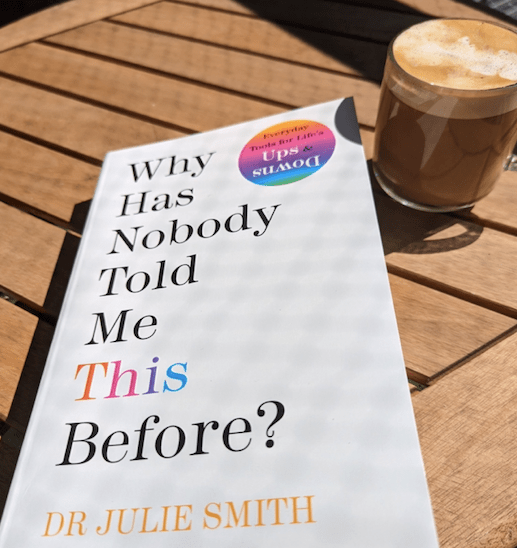
April book review – Why has nobody told me this before? 

April’s book review is Why has nobody told me this before? by Dr Julie Smith which aims to deliver a ‘part journal, part guide’ for understanding more about what it is to be human and what can help us navigate different aspects of our experience. 

The book is split into eight sections and covers low mood, motivation, emotional pain, grief, self-doubt, fear, stress, and creating a meaningful life. 

And at the back you can find references, resources, and spare tools to help you on your onward journey. 

The book comprises of top tips, suggested exercises, formulations, and specific psychological terminology which Smith explains in an accessible way. 

I like that the reader can pick a topic from the content list that feels most relevant and jump in at that point, you don’t need to read the book from start to finish. 

Another strength of the book is the inclusion of physical exercise as a key aspect of looking after mental health. I think this topic can be generally shied away from as clinicians sometimes think they need to stay in their ‘mental health lane’. But our brains are part of our bodies, so we need to start viewing them as connected and have open stigma-free conversations about exercise that are not aesthetically based. 

The final positive I’d like to highlight is Smith’s use of images which really drive her points home. She refers to the weaves of a basket, a man on the floor, and an artist observing his painting. These images are so easy for the reader to quickly call to mind which supports the learning process.

My main critique of this book is that within the section on self-doubt, there is a sub-heading – why you don’t need to work on your self-esteem – under which Smith describes self-esteem as ‘psychological rent that you can never stop paying’.

Although self-esteem isn’t a recognised ‘disorder’ in the Diagnostic Statical Manual (DSM-5) in the same way that other depression and anxiety presentations are, it is recognised in the manual as a key symptom of depression.

Furthermore, CBT pioneer, Dr Melanie Fennell designed an evidence-based CBT treatment protocol aimed specifically at self-esteem which is widely accepted and used within the field of psychotherapy and goes way beyond just writing positive affirmations as Smith appears to suggest. 

Self-esteem can absolutely be treated and improved through CBT. 

My second critique is Smith’s differentiation between stress and anxiety within the section on stress.

Smith describes what anxious experiences involve, ‘feelings of fear and excessive worry thoughts’. However, it’s not made clear how stress differs from anxiety as it’s described in the book as alertness and a fight or flight response in the brain which also occurs with anxiety. It would have been helpful for these to be explained more clearly, perhaps with a basic table to outline similarities and differences.

Despite Smith saying at the outset of the book that, ‘this book is not therapy in the same way that a book about how to maximise your physical health is not medicine’, I would argue that this book does get pretty close to therapy in a book with the accessible language and terminology, clear formulations, and exercises and the firm and fair tone used throughout. 

I would recommend the book to anyone who is interested in learning some fundamental psychological concepts, frameworks, and tools that can help with daily living. The book may be particularly helpful for those who cannot afford therapy. 

Why has nobody told me this before? Dr Julie Smith
Categories
Uncategorized

What my clients say

I have the privilege of being allowed into my clients’ worlds and it’s a real joy to reach an ending in therapy when the client feels ready to take on their next steps without me.

*Here’s what a recent client had to say about working with me:

“As a male I always found the thought of therapy quite challenging and believed that the anxiety and depression that I was feeling at the time was something that I had to handle alone.

However once my mental health began to effect my ability to perform at my job I realised that something had to be done.

Kirsty very quickly put me at ease and helped cultivate an environment that felt safe and non-judgemental.

She is an empathetic listener who has the ability to make you feel like you’re speaking to a trusted friend or family member and is keen to get to the route cause of whatever difficulty you are trying to overcome.

From the experience I have taken away real life skills that have helped me not only perform better at work, but have also improved many of my personal relationships immeasurably.

I’d highly recommend Kirsty to anyone that is either struggling or is looking to make improvements to their mental health.

This is due to her professionalism, ability to hold you accountable for your behaviours and actions and her knowledge of CBT which she delivers in an incredibly accessible manner.

At the end of the process I feel like I’ve not only gained techniques and skills that will help me get through any tough patches to come but also a trusted friend who I know will be available again if needed.”

*This statement was provided knowing that it would be shared on my website and socials and is therefore shared with the consent of the client.

Categories
Uncategorized

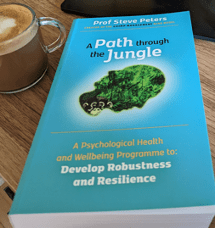
March book review – A path through the jungle

This month’s review is Professor Steve Peters’ second adult book, A path through the jungle.

Peters returns to build on his previous conceptual framework of the Chimp, the Human, and the Computer functions of the brain (see February book review for more) in this new programme which is designed to help the reader ‘develop robustness and resilience’. 

This book continues in Peters’ direct yet reassuring tone, uses clear explanations and diagrams throughout, and follows a well-defined structure by dividing the book into 8 Stages comprising of 2-4 Units each. 

The key difference between this and his previous book is that this one provides neuroscientific information and references to support his concepts so it’s ideal for anyone looking to really understand what’s happening from a neurological perspective.

Consequently, there are scientific terms used throughout such as amygdala, hypothalamus, and prefrontal cortex. 

If this really isn’t your thing and you only want to understand how your Chimp, Human, and Computer are working together – or against each other – on a day-to-day basis then you could stick with Peters’ first book. However, Peters provides clear definitions and explanations so it could be worth dipping your toe!

One of the main strengths of A path through the jungle is the clarity with which Peters writes both in terms of content and structure.

Clarity teamed with distinct colours and boxes bring different aspects to the reader’s attention which is an effective way to keep the content stimulating, not always easy with neuroscience!

Within the 8 stages are units which all follow the same format which creates a safe predictability for the reader. 

Each unit starts with a short comment which sets expectations, informative descriptions and illustrations, written examples to help the reader understand the translation of theoretical content into practice, scientific points, reminders, and exercises which are all centred on reinforcing the learning objective of the unit. 

My only critique is that this book doesn’t really tell the reader anything new if you’ve already read The chimp paradox as this book mainly builds on the Chimp, Human, and Computer constructs with the support of scientific evidence. 

So, although I would recommend this book, I’d say you could choose between The chimp paradox and A path through the jungle depending on whether or not you’d like the scientific information. 

A path through the jungle, Prof. Steve Peters
Categories
Uncategorized

New slots available!

I’m delighted to say that I am able to offer new slots on Mondays at the following times:

  • 9am
  • 3.30pm

Get in touch to arrange your first CBT appointment with me, kirsty.cbt@gmail.com.

Categories
Uncategorized

The what-if worrier

Oh, I come from a long line of worriers! 

I’ve always been a worrier.

If I didn’t worry, then I’d worry about not being worried.

These are just some of the phrases I hear from clients when they speak about worrying. 

We can all worry from time-to-time. But what-if worriers or people who have generalised anxiety disorder tend to have a frequent or constant feeling of anxiety and dread and can worry disproportionately about everyday things. 

The subject of the worry tends to change e.g., worrying about health for a while, then worrying about finances, then worrying about career and so on.

What-if worriers worry about possible outcomes, regardless of how likely or unlikely it is that the worry would happen:

  • What if it rains? What if it turns cold? What if I’m too hot?
  • What if I get ill? What if I can’t go to work? What if I can’t pay the bills?
  • What if I say something wrong? What if they don’t invite me back? What if I end up alone?
  • What if I have a panic attack? What if I can’t cope? What if I’m always like this?
  • What if I fail? What if I never progress? What if I’m stuck?

People who aren’t consumed by these worries might view the what-if worrier as irrational, or have a hard time empathising with them; they’ll simply think ‘well that won’t happen’, and move on with their day.

But for the what-if worrier, it can be exhausting and debilitating to consider possible outcomes, try to plan accordingly, and make appropriate decisions. 

The symptoms of this type of worry can vary from person to person but can include: 

  • Having worries that are catastrophic in nature.
  • Difficulty controlling worries.
  • Knowing the worry is disproportionate but not feeling able to let it go.
  • Feeling restless and having trouble relaxing.
  • Difficulty concentrating.
  • Trouble falling asleep or staying asleep.
  • Lethargy or exhaustion.
  • Headaches, muscle aches, stomach aches, or other unexplained pains.
  • Irritability or feeling on edge.
  • Over-preparation, procrastination, total avoidance.

With what-if worries, we don’t need to go down the rabbit hole of discussing each worry in detail; even if we solve a worry, there’ll always be another one coming down the tracks. 

Instead, it can be more helpful to consider what purpose the worrying is serving in your life and then take steps to consider the benefits and costs of living in this way. 

The 5 most common internalised reasons for worrying are: 

  1. To be prepared. If I worry about the worst, then I’ll be prepared.
  2. It’s viewed a positive personality trait. If I worry, then I’ll come across well.
  3. To prevent negative emotions. If I worry, then I won’t feel disappointed when the worst happens.
  4. To prevent negative outcomes. If I worry, then things won’t go wrong. 
  5. To help with problem solving. If I worry, then I’ll solve the problem.

Underlying each of these reasons, is an intolerance of uncertainty and a need to find control. 

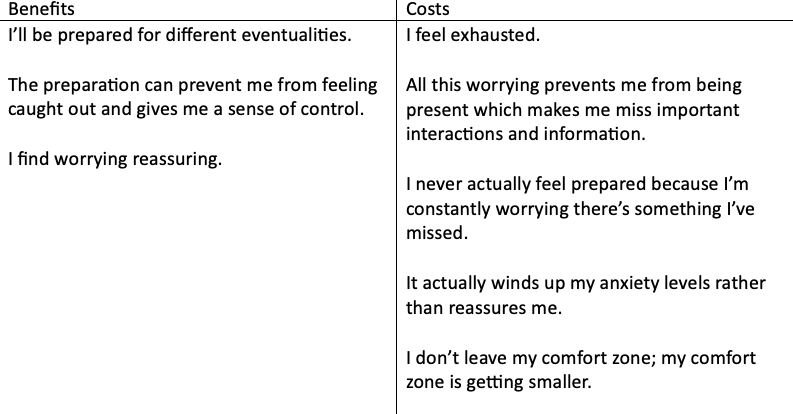
Once you’ve established your reason, you can write out the benefits and costs.

A short example: If I worry about the worst, then I’ll be prepared.

Write down all your benefits and costs and consider if you were to put the lists on a set of scales, which list weighs the most?

Now we need to challenge the worry.

Each of the following steps can seem tricky, but try to be firm with yourself, you can do it!

  1. Acknowledge that you’re worried and remind yourself that you’re in the habit of worrying when it’s not necessary so it’s likely that this is another example.

  2. Establish if the worry is real or hypothetical.  

    Take your worry to court! What’s the evidence for and against this worry? Let the judge decide if it’s a real worry that’s worthy of your time and effort.

    If it’s a sunny day, worrying about being caught in the rain is a hypothetical worry because the evidence is that the sun is shining. 

    If you’ve got a cough, worrying about it being a sign of a serious illness is hypothetical because the evidence is that coughs and colds are common (do get it checked if it’s been with you for longer than 3 weeks). 

  3. If it’s hypothetical, change your attention to let the worry go.

    Read a book, do some exercise, talk to a friend about something unrelated.

    The brain will likely still want you to worry but keep guiding it back to the activity you’re doing. 

  4. If it’s real, make a plan then let the worry go. 

    Once you have your plan in place, you can feel safe in the knowledge that you really are prepared then change your attention by doing something you enjoy.

    If you have a presentation at work or at university that you’re worrying about, take action. Make sure you have what you need to present e.g., presentation slides and your script. Look out the clothes you’re going to wear. Consider your transport to the event. 

With worrying, we want to control the controllables and let go of the rest. This tends to be easier said than done but consistent practice will go a long way! 

Remember, worrying is normal and natural and impossible to stop completely. 

The purpose is not to stop you from worrying, it’s about being able to manage and cope with worries and self-soothe.

A therapist can help you work through this if you’re still struggling.