Categories
Uncategorized

February book review – The chimp paradox

February’s book review is The Chimp Paradox by Prof Steve Peters.

A key aim of the book is to minimise psychological and behavioural dysfunction by taking the reader on a journey through the ‘psychological universe’ which involves understanding yourself, understanding others, communicating effectively, living in your world, maintaining your health, being successful, and being happy.

The book is divided into three parts: 

  1. Your inner mind explored,
  2. Day-to-day functioning,
  3. Your health, success, and happiness.

Part one’s information on how the mind works in the context of the human, the chimp, and the computer provides the reader with a solid foundation of the inner workings of the mind. 

Part two extends the education to understanding and communicating effectively with others and creating suitable environments for dealing with stress (both immediate and long-term stress). 

Part three moves the reader towards future planning by outlining how to set up for success in terms of physical and mental health, maintaining progress and dealing with setbacks, leaning on others for support, and developing confidence and happiness through positive mindset. 

Peters describes the chimp paradox as a simplified version of our brain; an easy working model comprising of three parts – the human, the chimp, and the computer – which manifest in our thinking and behavioural patterns.

It is acknowledged at the outset that the brain is much more complicated than this model and has many functions which aren’t covered in this book; the purpose is to give the reader information that can be easily transferred into actionable steps.

The human and chimp aspects represent the frontal (rational and logical) and limbic (emotional) systems in the brain respectively and the computer represents the brain’s information storage system which we use as a sense-checker before acting. 

Peters describes the problem that we find ourselves in with our human and chimp modes as having two beings who try to work together but as they have different ‘personalities’ and agendas, they can clash and leave us tied in knots or acting erratically. 

The imagery of the human, the chimp, and the computer is an incredibly quick and effective way to stop and check in with ourselves:

  • Am I responding from a logical, rational place = human 
  • Am I responding from an emotional, instinctive place = chimp
  • Do I need to update my frame of reference = computer

Once we’ve answered these questions we can CHOOSE how to act. 

The use of case studies and examples throughout supports the information, and each chapter has suggested exercises which help the reader consolidate learning and consider how it can be applied. 

Peters provides helpful definitions which differentiate between concepts such as hurdles, barriers, and pitfalls, and goals and dreams, and expertly manages to strike a balance between delivering clear information and diagrams in a simple and concise manner without being patronising or condescending to the reader.

Peters’ tone enables the reader to be self-compassionate by removing the fault or blame of certain reactions from the reader and redirecting it towards the inner chimp. 

This isn’t to say that Peters wants the reader to stop taking responsibility, quite the opposite in fact! 

Peters reminds the reader throughout that we are in control and have a choice on how to act and if the chimp gets the better of us it’s our job to correct the mistake and apologise where necessary. 

The Chimp Paradox is an easy-to-understand approach to complex brain science which makes it an ideal read for anyone interested in learning more about the how the human mind works and how to manage it effectively; I’d highly recommend it!

Look out for my Path Through the Jungle review in March which is the second adult book by Prof Steve Peters.
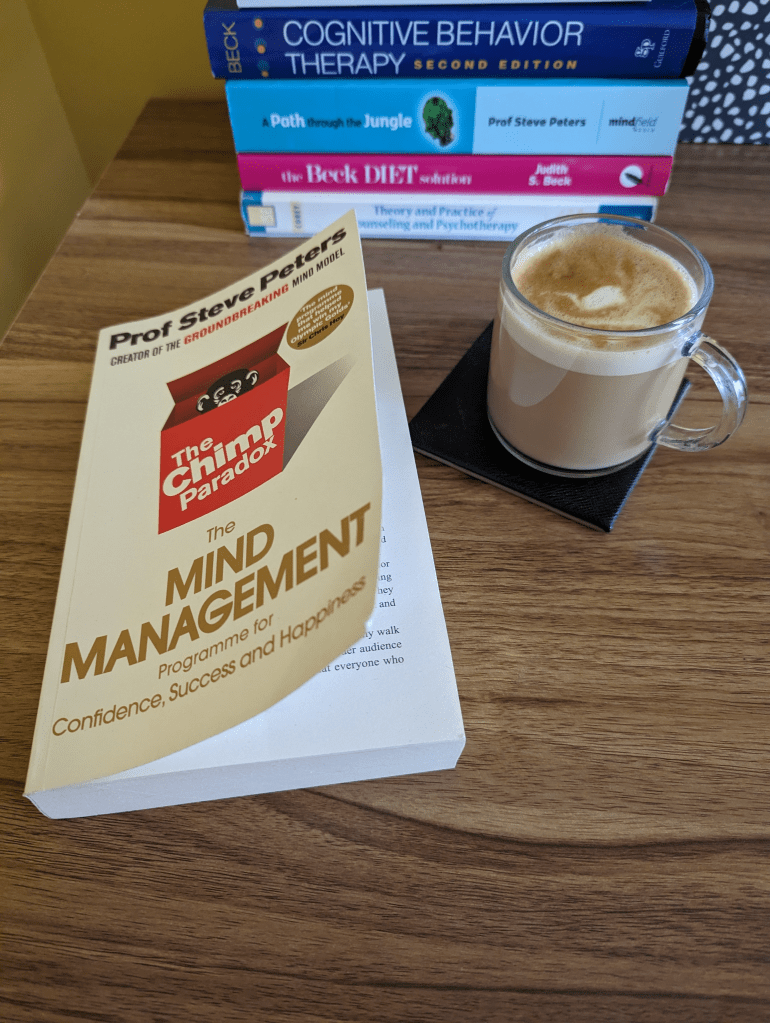
The chimp paradox, Prof Steve Peters
Categories
Uncategorized

Your first therapy session – what to expect.

I welcome you into the Zoom room.

I say hello, check I can hear and see you and you can see and hear me.


I tell you about the confidentiality conditions.

You will have had the opportunity to read over the confidentiality policy ahead of the session as I send it to you by email before we begin. This is just a chance for me to remind you that everything will be confidential between ourselves unless there is a serious or imminent risk to either yourself, another person, a child, or if any criminal activity was disclosed.


I set an agenda and ask if you want to cover anything I’ve not mentioned.

It’s quite natural for you to not have anything to add to the agenda in week one, a lot of people are happy to take my lead. But if you do have something, feel free to add away! The reason an agenda is set is so that you know at the beginning what to expect, there’ll be no hidden surprises. Although the agenda is set in the beginning, things can be added later if something pops up or you forgot at the beginning.


I ask you to tell me what brings you along, what’s happening in your world, and what you’d like to work on.

This is where you get the chance to explain a bit about what it’s like to be you right now. I’ll guide you by asking what you think, how you cope, and how you feel about things. Try not to worry about getting stuck or not knowing what to say; it’s my job to help you find the words. I’ll ask you what it is that you want to work towards, this is also known as therapy goals.


I’ll summarise what you said to make sure I’m hearing you right.

I’ll repeat back to you what I’ve heard either using your own words or a paraphrased version and you’ll be able to confirm if that’s right, if there’s something I’ve missed or misheard, or anything else you’d like to change or add. This helps me to make sure that I’m on your page and can reassure you that I’m really hearing your perspective.


I’ll explain exactly what I offer and what you can broadly expect.

I’ll give you an overview of CBT, how I work, what the expectations are of-and-for you, and how we’ll work together. You can ask any questions you might have, some commonly asked questions can be found here: https://therapywithkirsty.co.uk/faqs/


We can decide on an actionable step for you to take away.

In CBT we call this ‘homework’. It’s not the same as school – I’m not your teacher, I’m not assessing you, you don’t need to feel guilty if you don’t do it. The aim of the homework is to help you move forward, so it’s completely up to you whether or not you commit to it. We have 168 hours in a week, we’re together for 1, so it’s something you can do outside of our session to continue helping yourself along.


We book in our next appointment.

Appointments are usually on the same day, at the same time each week but we can firm this up as I appreciate that sometimes life gets in the way.

And that’s it!

You’ve just completed your first therapy session! That wasn’t so bad, was it?

Categories
Uncategorized

The truth about perfectionism

When you hear the word ‘perfectionism’, perhaps you think of a highly efficient, detail-oriented person who is tidy, organised, and prepared. 

The one who uses to-do lists, labels, spreadsheets, systems, and diaries.

The one who likes to get things right, who works hard, who turns up 20 minutes early rather than 1 minute late.

The perfectionist might have ideas like:

  • ‘If something’s worth doing, it’s worth doing right’
  • ‘I must do it properly’
  • ‘I must be perfect’

The truth is that perfectionism can actually look like:

  • Procrastination:
    I’m not sure about this, so I’ll do all these other things so I can still feel productive.
  • Avoidance:
    I better not do that because I can’t do it perfectly.
  • Self-criticism:
    I’m so terrible because I didn’t get it correct straight away.

The perfectionist uses lots of ‘shoulds’ and ‘musts’ and finds it hard to recognise achievements; it’s always about how to improve.

Driving the perfectionism is fear.

Fear of failure, fear of being out of control, fear of being found out. 

A belief that ‘I’m not good enough’, ‘I can’t cope’, or ‘I am stupid’.

Perfectionism is a protective coping mechanism for these fears and beliefs and can sound something like:

  • ‘If I’m prepared, then I’m in control’ 
  • ‘If I stay quiet, then I won’t look stupid’
  • ‘If I criticise myself, then it won’t hurt when others point out my flaws’

But perfectionism can become debilitating. 

It stops us from moving out of our comfort zone to try new things. 

It keeps us stuck. 

Because we can’t prepare for everything, we can’t be in control all the time, we can’t be amazing at everything. 

The perfectionist has a hard time accepting that and letting go because what will that look like? What if I come undone?

The perfectionist can learn to let go – even just a touch – and find out that standards can remain high while also feeling joy and achievement rather than being driven by fear.  

Perfectionists can learn that good enough is good enough. 

Categories
Uncategorized

Problematic people pleasing

Saying yes too often to other people EVEN if you don’t want to? To-do list growing? Too many social plans?

People pleasing can seem nice on the surface but it can actually become really problematic for you, your relationships, and your lifestyle.

Perhaps you’re already finding yourself:

  • Cancelling plans, turning up late, or leaving early to fit everything in.
  • Taking time off work because you’ve reached burnout or you’ve become really rundown.
  • Becoming resentful because it feels like you’re always giving but never getting or working round the clock.
  • Feeling stressed, anxious, worried, and overwhelmed because you don’t have enough time and space.
  • Creating extra things to do in the hope that it will please people even if they haven’t asked you to.

A wee extra favour for someone here or there is ok, as is having a lot on at work one particular day or week, but it’s important to be realistic about the associated costs and not just leap into saying yes right away.

The fact of the matter is:

WE CAN’T POUR FROM AN EMPTY CUP.

We need to find away of filling our cup back up and only giving what we’re truly able and willing to give without it being detrimental to ourselves.

Open, honest, and transparent boundaries which are effectively communicated to others can help.

The part about communication is important because we can’t expect other people to mind-read and somehow just know and respect our boundaries.

To start thinking about your boundaries, consider your reasonable time limits for work, chores, exercise, relaxation, and socialising:

  • Book time with yourself in your diary for the different things you want to do or put a big ol’ line through it so you don’t book someone else in.
  • Create time and space to THINK about your answer by consulting your diary first, ‘can I get back to you on that I need to check my diary’.
  • When you say no to socialising, keep it simple and honest, ‘sorry I won’t be able to make it this time, I have a lot on, looking forward to catching up soon’, or ‘I’m not free this week but what about the following Saturday, I’m free then’.
  • At work check your to-do list, delegate, and share responsibility, ‘I can certainly help with this project but I only have an hour that I can dedicate to it due to the other tasks on my caseload so I’ll need some support, who else can contribute’.

A common fear is that putting boundaries in place is going to be met with judgement, that people will think you’re rude, bad, or lazy, ‘If I say no, they’ll think less of me’.

This is rarely the case! It’s actually helpful for the other person to know where you really stand.

Top tip for saying no:

Try to AVOID exaggerating or adding extra untrue excuses:

  • ‘I’m busy on Friday’ is acceptable. 
  • ‘I’m busy because my pet fish is sick, and I’ll need to take him to the vet before going to check on my elderly relative’ when that’s not true is not ok.

People know when you’re telling porkies (even if they don’t say it), so honesty really is the best policy in these cases.

Being honest actually helps you when you’re worried about being viewed as rude, bad, or lazy because you’re showing the person respect which in itself counteracts your worries.

There are a number of positives from operating with effective boundaries:

  • Freedom! You free up time and space in your diary to restore your balance and you free up your mind so you can think more clearly.
  • Trust. People will be able to trust you when you respond to their requests to make plans because you’re not fibbing about why you need to cancel.
  • Dependability. People will be able to depend on you turning up on time, staying throughout, and not cancelling; knowing that people can depend on you will make YOU feel good.
  • Contentment. Instead of resentment growing, contentment will take its place. It will no longer feel like you’re always giving and not getting.
  • Peace. You’ll feel calm and in control of your diary with sufficient time for yourself.

Sound good? Book in time with a therapist if you need some more help to work on this, it’s what we’re here for.

Categories
Uncategorized

Coming soon…

The book reviews were on hiatus for the month of January as I took a little time to read non-therapy related books.

But I’m glad to say the next review will be coming soon – and for the first time it’ll be a two-parter!

Part 1 will be ‘The Chimp Paradox‘ and Part 2 will be ‘A Path Through the Jungle‘; both written by Professor Steve Peters who you might have heard on Steve Bartlett’s podcast, The Diary of a CEO.

So keep your eyes peeled in the month of Feb for Part 1.

In case you’re interested, my top read from this last month was Anne Frank’s, ‘The Diary of a Young Girl‘:

The diary of a young girl, Anne Frank
Categories
Uncategorized

Messages from childhood

‘Ok, next lamppost’, my mum would say to 5 year old me.

This was a boundary.

She gave me the freedom to run but only as far as the next lamppost so that her eyes were on me, ensuring my safety. I gained a sense of autonomy and independence within safe boundaries.

The boundary became a challenge.

Seeing how quickly I could run to the next lamppost. Or how many times I could run to the lamppost and back to her until she’d caught me up. I gained achievement and enjoyment.

The challenge became a short-term goal.

When I go running as an adult and I think of giving up, I tell myself, ‘Ok, next lamppost’, instead of thinking about how far I still have to go. This way of thinking breaks down my goal distance for the run into smaller, manageable chunks. Once I get to the next lamppost, I again tell myself, ‘Ok, next lamppost’. I continue with this for as a long as I need; sometimes it’s just a couple of lampposts to get me going or sometimes it’s the whole way home! I gain drive and determination.

The goal became a metaphor.

In my life, when things get tough, I mentally change the ‘next lamppost’ to just focusing on the next task, not getting bogged down by other things on the to-do list, just do the next thing. Before I know it, I’ve ticked off so many things on the list, just by focusing on one small goal rather than the bigger picture. Small consistent steps add up. I gain hope and forward momentum.

It’s amazing how the messages from childhood shape our worldview as adults.

The concept of messages is something we need to raise our awareness of in therapy.

What were those messages from childhood?

What did they tell us about ourselves, other people, and the world?

How do they impact us now as adults in terms of our thoughts, beliefs, and behaviours?

What’s helpful and unhelpful about this impact?

What can we do to make small and consistent helpful changes?

A therapist can help you unpack all this and work towards meaningful change.

Categories
Uncategorized

What is CBT?

CBT stands for Cognitive Behaviour Therapy. Cognitions are what we think, behaviours are what we do, and these aspects impact how we feel.

CBT is all about identifying and restructuring unhelpful thinking styles and behaviour patterns and working towards goals.

Goals can be really varied from person to person but can involve things like increasing self-esteem, reducing imposter syndrome, communicating effectively, processing the past, or finding focus or purpose; however, they’re always specific to the client. 

CBT can stay focused in the here-and-now looking at problem solving in day-to-day life or can delve deeper into the past to see where certain thinking styles or behaviours come from. Perhaps there are some unresolved issues, experiences, or traumas, or perhaps you’re just curious to make connections between past and present.

The word I’d use to describe CBT is proactive.

I’m not here to fix you or tell you what to do. I’ll be alongside you helping you set and work towards your goals. You’ll complete homework in between sessions, and I’ll ask you for feedback at the end of each session and items to add to the agenda at the start. 

Speaking of agendas – each session will have an agenda set at the beginning to make sure we’re always working towards your goals. There can be a bit of flex to talk about things that might pop up or become important to you but broadly speaking our work is about helping you to achieve your desired goals. 

Although there’s an expectation for you to do the work, I am absolutely here to help you. I’ll provide you with ‘psychoeducation’ (explanations about how we work as humans) as well as tools and strategies that are proven to help reframe our thoughts and test out new alternatives. 

There are 168 hours in a week and you’re with me for just 1.

So, it’s really about what you can do out-with our sessions to maximise your progress. I can help you with this by supporting you to think of homework exercises to complete (reflections, written exercises, and behavioural experiments) that are relevant to your goals. 

Before we finish, I’ll take you through how to maintain your progress and prevent setbacks so that by the end, you can ‘be your own therapist’. You’ll know your sore or tricky points, your typical unhelpful patterns (and why they’re there), and you’ll have tools and other coping strategies to help you from falling into the same old patterns.

I think of myself as a passenger on your bus – you’re always driving, I just get on for a couple of stops until it’s time for me to go.

Categories
Uncategorized

Get yourself to the top!

My practice is currently full so now is the time to get yourself to the top of my waiting list.

I provide sessions on Monday evenings, Tuesday evenings, Wednesday evenings, Friday mornings, and Friday afternoons.

Drop me an email and we can have a chat about how I work and what you’d like to work on to see if we’re a good fit for you.

Then you’re all set to be added to the top of my list as soon as a slot becomes available.

What are you waiting for?

Make 2023 the year you invest in YOU.

Categories
Uncategorized

What to expect

What to wear? The room in the background. Who the therapist is going to be and what they’re going to be like.

Signing into therapy for the first time can be daunting.

What you can expect to see when you log in to do Therapy with Kirsty is in the photo below 👇

❄ In winter you’ll usually find me in a jumper

👓 I’ll be wearing my glasses

🌱 You might see my plant, diffuser, painting in the background.

The things you might not always see as they’re out of view of the online window but are there too are:

🗒️ My notes within my reach so I can jot things down as we speak.

📒 My paper diary on my desk so we can agree and book our next appointment.

☕ If you have an early or lunchtime slot with me I’ll probably have a good coffee nearby or in the evening a wee mint tea, along with my trusty water bottle that comes everywhere with me

As a therapist I don’t need my clients to dress up for our sessions or to worry themselves about tidying their room.
My hope is for you to feel comfortable and safe in a quiet place so that we have the time and space to talk about you and to work towards your goals.
Categories
Uncategorized

Design your ideal 2023 with this exercise

I’m back from my festive break feeling rested and restored, I hope you are too.

The new year can be a time that brings up a whole host of different emotions – perhaps joy, or hope and determination, or sadness and grief, or anxiety about what ‘lies around the corner’ in this new year.

Your feelings are valid.

Whatever you’re feeling, this exercise can help you create and sustain forward momentum towards your goals for this year, even if you don’t know what your goals are yet!

Close your eyes and imagine you wake up on your best version of Sunday 31st Dec 2023.

Look around you.

What do you notice?

How do you feel? What are you doing? What are you wearing?

How do you spend your time? Are you working, studying, volunteering, exercising, socialising, holidaying?

What do you eat? What do you drink?

Who is in your life? What do they notice about you?

How does all of this make you feel?

Sit with this feeling for a few minutes before opening your eyes.

Now, on a scale of 0-10 (0 being not at all up to 10 being living your ideal future), what number represents where you are now? And what indicates to you that the number is accurate for now?

It doesn’t matter if you are a 0 or 1 on the scale right now, this is a starting point.

What does the next number up on the scale look like? How would you know if you’ve reached that number?

What action could you take today to work towards that next number on the scale?

You now have a plan.

Once you attain the next number on the scale, acknowledge your progress and then think about what you can do to work towards the next number on the scale.

Remember to be kind to yourself – working towards change can be hard at times, setbacks happen, it’s not all linear.

Start now. Keep going.

You’ll be amazed what you can achieve.

Wishing you the very best for 2023!