I’m out of office until Jan 2nd 2023 and will respond to emails on my return.
Wishing everyone a happy & healthy festive season!
I’m out of office until Jan 2nd 2023 and will respond to emails on my return.
Wishing everyone a happy & healthy festive season!
December’s book review is all about love.
Gary Chapman details how we recognise and express love in our relationships in his book, The 5 Love Languages.
This book helps you to identify your own primary love language and that of your spouse and, perhaps more importantly, how to learn to speak the language of you partner i.e., learn to meet your partner’s needs in a way that’s meaningful to them.
The five languages are: Words of affirmation, Acts of service, Receiving gifts, Quality time, and Physical touch. *
You might be thinking, most/all of these are important for a successful relationship. This book doesn’t deny that. Instead, it helps you to work out which is the most important to you and to your partner, the thing you each can’t live without.
When you know what your priorities are, you can act accordingly.
What the book achieves so effectively is the overarching metaphor of language. Just as we can spend all day speaking English to try to explain a point, if the listener only speaks Spanish, then we’re getting nowhere, Chapman demonstrates that so too is the same with love languages – if we’re communicating via Acts of service but the recipient only recognises Quality time, then we’re hitting a brick wall.
We need to understand what’s important to the recipient. This isn’t the same as saying the other person’s needs are more important than our own, rather that we’re willing to speak their language to meet their needs with hope that they’ll reciprocate with learning to speak our language too.
We’re choosing to love our partner in a way they’d like to be loved.
Chapman writes in an accessible way and clearly explains the five languages with the support of case studies, prompting questions, and language-specific tips throughout. There is also a questionnaire for you and your spouse to complete at the end of the book which is a fun and friendly way to open discussion.
Chapman remains neutral throughout and does not say one language is better than another or suggest letting go of your language. The book helps the reader to notice and accept what’s important to each person in the relationship and how to act in a helpful way in line with these needs and desires.
The book is written with married couples as a target audience, but it seems as though it would be helpful for any long-term relationships; those that are a couple of years in, living together, or passed the ‘honeymoon stage’.
Chapman also has created subsequent editions of the book for men, singles, teens, children, and military personnel.
I’d highly recommend this book to anyone looking for their relationship to go the distance! It’s a quick read with easily transferrable tips and a tone that feels welcoming and safe for relationship discussion.
* Words of affirmation = your partner gives compliments and appreciation e.g., saying ‘I really like…’.
* Act of service = your partner does things for you e.g., doing the washing, taking the bins out.
* Receiving gifts = your partner buys/makes physical items e.g., buying a bunch of flowers.
* Quality time = spending time together without distraction e.g., dinner without phones.
* Physical touch = physical contact e.g., hand holding, cuddling, sex.

Our thoughts impact how we feel. Unhelpful thoughts are rigid, goal blocking, and not reality tested. So, when we get stuck in unhelpful thinking habits, we feel sad, anxious, or distressed.
However, we have the power to change how our brains work by creating new habits and pathways; this is called neuroplasticity.
Unhelpful thoughts are not a personal failure and you’re not stuck with them for life. Just like we can change our bodies through physical exercise, we can change our minds through mental exercise.
Here are 4 steps to help you along with breaking free from unhelpful thinking habits:
Step 1: Identify your habits.
Have a read through the categories below and consider which sound familiar. There might be one or two that ring true or perhaps they all ring a bell; that’s ok!
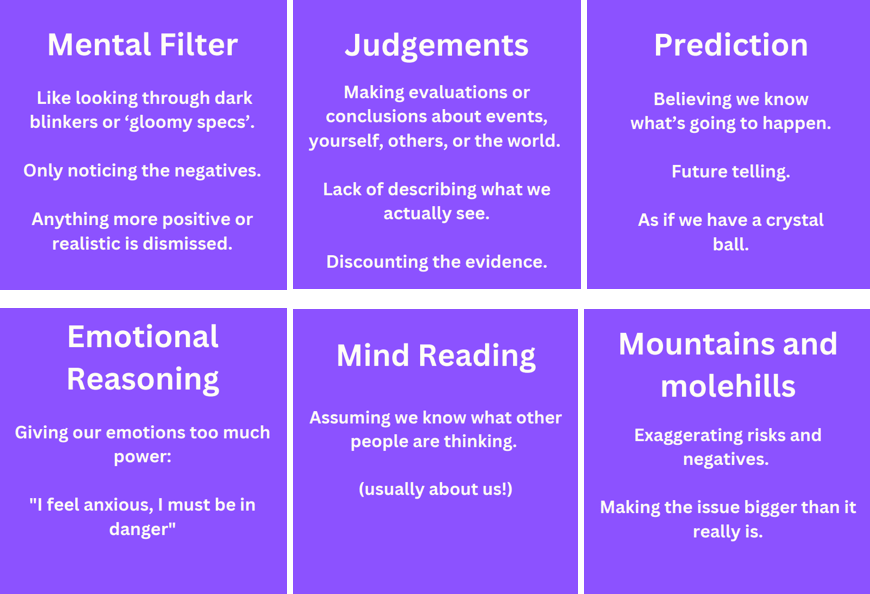
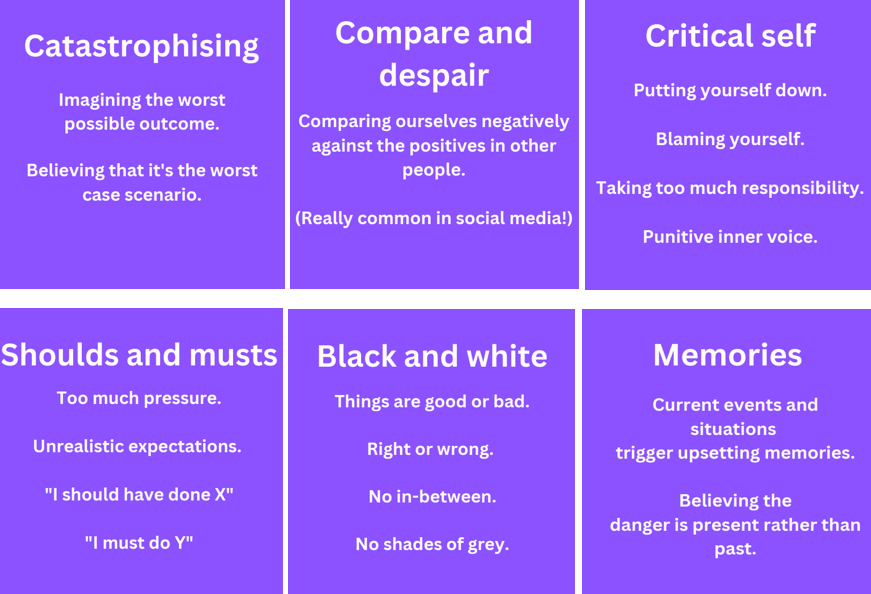
Step 2: Become aware of your habits.
You are not your thoughts. Awareness creates a distance between you and the thoughts so that you can begin to make positive changes.
An easy way to increase your awareness is to think about a recent time in which you felt sad, anxious, or distressed and to write down the thoughts that came into your mind at the time. Then notice which unhelpful thinking habits occurred.
Once you have this information, ask yourself, ‘where else does this play out and with whom?’.
Knowing which situations set off the habits makes it more possible to notice them when they appear in your life.
Step 3: Change your habits.
Now for the fun part: challenging and changing your thoughts. Ask yourself:
Step 4: Reinforce your changes.
This isn’t always easy as your brain will want to take you back to the familiarity of your previous habits. But regular practice goes a long way.
It’s natural to feel a bit frustrated when you notice the unhelpful habits playing out. But try to be kind to yourself, ‘oh, I’ve wandered off down my unhelpful path’ and gently guide yourself back towards Step 3.
You’ve learned many things over the years: reading and writing, perhaps swimming, riding a bike, or learning to drive. At first these things were a challenge, but with time and practice they become automatic. You’ll get there with your new helpful thoughts too.
Although anxiety can be a precursor for a panic attack, they are separate experiences with distinguishable symptoms.
As the name suggests, a ‘panic attack’ is when it feels as though we are suddenly assaulted by our symptoms. Panic attacks are intense and brief in nature and are surprisingly convincing that we are about to die.
This is terrifying.
Panic attack symptoms can vary from person to person but are very much a visceral experience and hyperventilating and heart palpitations are the most common features.
It is incredibly difficult to think during a panic attack because the physical symptoms have gripped us. There is a sense of immediate relief when the panic attack stops, and normal functioning can resume although there may still be a sense of ‘what the hell was that?’.
Because of the intensity of the physical symptoms, we can become highly avoidant of the place where the panic attack occurred as we become fearful that the place will set off another attack.
Anxiety on the other hand can be with us for some time (days, weeks, months, years) and can change between feeling mildly anxious up to severely anxious. We can feel severely anxious without ever experiencing a panic attack.
Anxiety has physical symptoms in common with panic attacks such as shortness of breath, sweating, and stomach problems but anxiety also occupies the mind – we can become full of worry and anxious thoughts – which in turn impacts things like our appetite, sex drive, and sleep.
Avoidance can also play out with anxiety as we’re uncertain that we’ll be able to cope with the situation.
Here are some of the key differences in symptoms between panic attacks and anxiety:
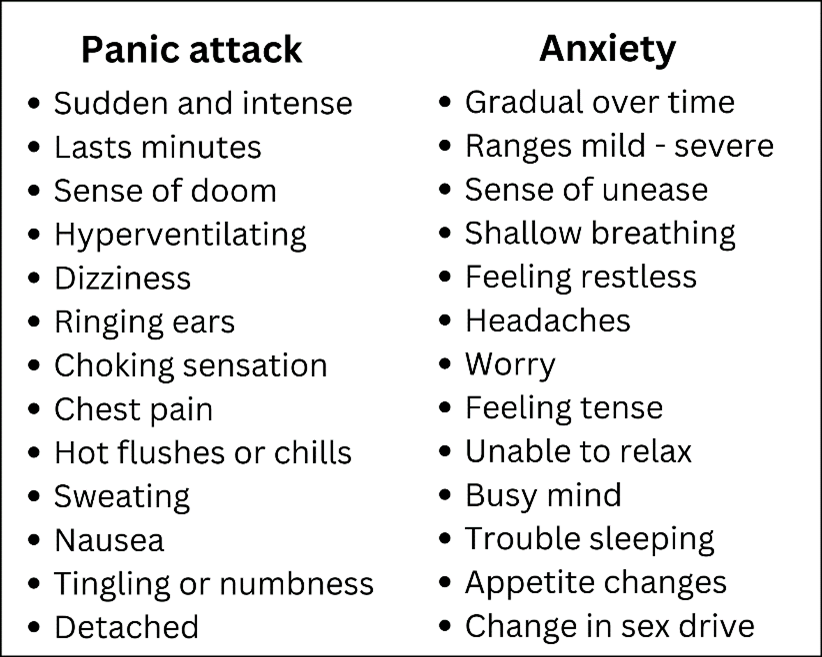
The term ‘anxiety attack’ also gets used in the media and in conversation however this is not recognised from a clinical perspective; it’s either a panic attack or a form of anxiety.
Knowing the difference can help you to understand what it is your experiencing which can support you in dealing with the root of the problem. A therapist can help you with this if you’d like to delve a little deeper or learn coping strategies.
Ever wondered what your brain is up to? Well, The Idiot Brain by neuroscientist Dean Burnett attempts to explain the workings and failings of the human brain. Supported by referenced scientific studies, The Idiot Brain gives an evidence-based account of some of the key concepts that play out in our daily lives.
The book is split into eight chapters: Mind Controls; The gift of memory (keep the receipt); Fear: nothing to be scared of; Think you’re clever, do you?; Did you see this chapter coming?; Personality: a testing concept; Group hug!; and When the brain breaks down. Within each chapter, Burnett lays the groundwork for each concept and provides salient points as to the workings of the brain. However, if you’re looking for clear-cut answers, you might be disappointed as Burnett reiterates throughout the book that the brain is a complex system and is liable to misadventure.
A strength of The Idiot Brain is that it is relatively jargon-free with explanations provided for areas and functions of the brain meaning that it is accessible for anyone who is interested in reading more about how our minds work. This book is ideal for those who are seeking to dip their toe into brain-related content or for those who are already familiar.
Although the friendly tone can put readers at ease when discussing a complex subject matter like the human brain, personally I found the use of humour to be a little try-hard and used too often which for me detracted from the interesting content at times. That said, I appreciate that humour allows us to kindly laugh at our fallible brains rather than to punitively dissect our failings.
For me, The Idiot Brain wasn’t a super quick read or one that I couldn’t put down, but one that I would still recommend to those who are interested in gaining insight into what’s going on up top.

Coming to therapy isn’t like going to the GP and getting a pill to fix the problem. The therapist doesn’t hold all the answers. There’s no secret shortcut to be shared. Therapy isn’t about the therapist ‘fixing’ the client. Our thoughts and feelings aren’t ‘wrong’, so there’s nothing to fix.
It’s helpful to move away from the idea of ‘fixing’ towards the idea of ‘noticing’.
Is this just semantics? Actually, this change in language can turn down the volume on the internal self-critical or perfectionist voice and give us time and space to neutrally observe before choosing how to respond. The word ‘notice’ prevents blaming ourselves, parents, caregivers, teachers, peers, or employers for our experience because we’re not approaching with judgement. Noticing helps us slow down so we can begin to form a clearer picture of what’s happening.
Noticing isn’t always easy, it’s an art, a skill to be practiced, a new habit to form.
A helpful starting point is identifying our triggering situations – those moments that often cause us anxiety, low mood, and distress etc. By knowing our typical triggers, we can head into them with open eyes and curiosity to begin noticing what’s happening. What am I thinking? How am I feeling? What am I doing? Is this a vicious cycle that I often go round?
Becoming aware of the body is hugely beneficial as physical symptoms are indicators of our emotional state; our body is constantly giving us clues. Look out for a racing heart, feeling clammy, sweaty, and flushed, a knot in the stomach, a tight chest, shaky limbs, or sometimes an emptiness. These are signals from the body to let us know that something doesn’t feel safe.
We can notice possible origins of our current thoughts, feelings, and behaviours. When was the first time I remember feeling this way or believing this was true? What was happening? Who were the key players involved that shaped this perspective? This isn’t about blame. It’s about noticing past experiences that shaped a child’s perceived reality and how that’s informed our thinking styles and behaviours in the present.
You can ask yourself some of the questions above or you can work with a therapist.
Together with a therapist, clients notice what’s currently happening and have the opportunity to reflect, to be guided, to be gently challenged, and to consider helpful and healthy ways of thinking and behaving which in turn improves how we feel. This helps us take ownership for our own wellbeing which can be incredibly powerful.
To notice is to begin our own positive change.
This week Scotland has plunged into the grey skies of October, here we call that weather ‘dreich’ (adj. dreary, bleak).
While a lot of people might not like seeing these weather changes, for some it can be really quite disruptive and have quite an impact on day-to-day activities. For this latter group, they can be affected by the following symptoms:
When experienced as a result of the changing seasons, these symptoms point to the possibility of Seasonal Affective Disorder (SAD), also known as ‘winter depression’.
Although the exact causes aren’t fully understood, or why it affects some more than others, it’s possible that SAD is linked to less exposure to sunlight which prevents the hypothalamus in the brain working as it should. This has a knock-on effect as our circadian rhythm (the body clock), production of serotonin (the happy hormone), and the production of melatonin (the sleepy hormone) all go out of whack leaving us with the symptoms listed above.
So, what can be done about SAD?
Well, the main approaches are lifestyle choices – regular exercise, eating healthily, drinking water, keeping a structured daily routine. It can be hard to do these things when we feel low and lethargic, but they can really help our body and mind to regulate.
Light exposure is also beneficial. This can be achieved by spending time outdoors where possible. This can be tricky if you work full-time so things like getting off the bus a stop early or going out for a walk at lunch can make the most of those precious daylight hours. A SAD lamp or light box simulate exposure to light. Putting this on first thing in the morning on those grey days provides the brain with some much-needed light.
CBT is shown to help SAD as it explores ways in which our thinking styles and behaviours impact how we feel, so working on healthier thinking styles and behaviours can create a more balanced perspective during what can seem like an uncontrollable situation.
Taking vitamins such as vitamin D, vitamin B, and iron can help with energy levels and tiredness, however, vitamins aren’t recognised by the NHS as treatment for SAD; speaking with a trained nutritionist would be recommended for advice around this.
A GP can prescribe antidepressant medication such as ‘selective serotonin reuptake inhibitors’ (SSRIs) which can support the functioning of the happy hormone during the winter months.
Finally, like with most mental health struggles, a good dose of self-compassion can go a long way. We can’t pour from an empty cup so having some time for enjoyable activities and treating ourselves with kindness is important.
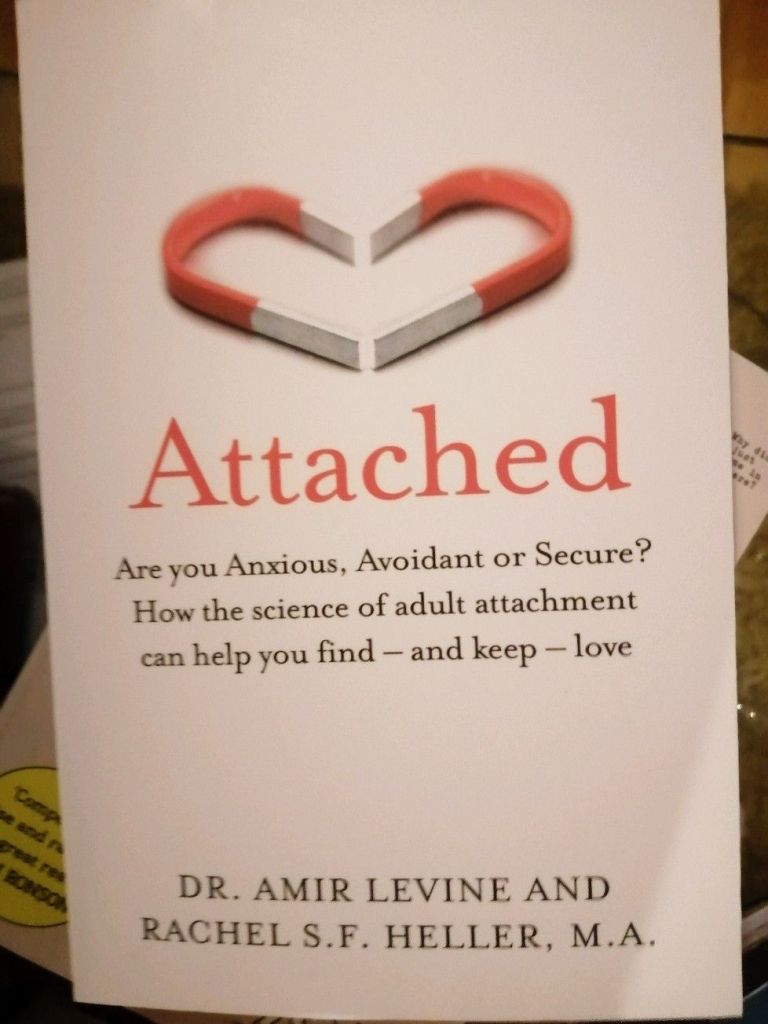
Attached by Amir Levine and Rachel S. F. Heller is an excellent read for those wanting to learn more about who they are in relationships – secure, anxious, or avoidant – and how to make the most of this knowledge. Information, case studies, and practical questionnaires enhance consolidation of learning and enjoyment. I could hardly put it down and would definitely recommend it!
Here’s a short overview of the attachment styles:
Those with a secure attachment style feel at ease explaining their needs within a relationship, feel confident that their needs are valid, and expect that their partner would react positively to hearing their needs. Secures cope well with emotional and physical intimacy, allowing space and closeness, and understand that disagreements happen within a relationship without it meaning a personal attack.
Those with an anxious attachment style require reassurance in a relationship, with a tendency to worry about their own lovability or worthiness. Anxious people can be hyper-aware of something being ‘off’ in the relationship and will engage in safety-seeking behaviours to settle back down. Anxious people may strive for physical intimacy and acceptance from others. Anxious people can sometimes be referred to as ‘needy’ which is unhelpful as we all have needs, we just display and communicate them differently.
Those with an avoidant attachment style find it difficult to express their needs and feelings in a relationship and can view a relationship as a loss of independence and autonomy. As such, emotional and physical intimacy can be challenging as the avoidant person will seek to maintain distance. Avoidants are high in confidence and don’t rely on others for reassurance. They’re not necessarily lonely – they may have numerous friendships or sexual partners, but these relationships are usually only surface level which means that meaningful relationships don’t occur (as we need to get deep to get meaningful).
Our brains are malleable and, as such, it’s possible to work on our attachment style. But first, we need to acknowledge what our attachment style is, be willing to put in the work, and then – you guessed it – actually make some changes!
The book, Attached is a great way to get started, and working with a therapist can help you navigate your new-found knowledge.
Setting boundaries is important. Boundaries let other people know what to expect from us, what we find acceptable, how we want the relationship to work.
But who is responsible for keeping the boundaries?
Us.
Example:
I could set a boundary that I won’t use my phone after 7pm. But a family member keeps phoning me at 7.30pm. I keep answering the phone and I feel annoyed and frustrated that the person isn’t respecting my boundary 😤
Actually, it’s me that’s not respecting the boundary. If I don’t want to use my phone after 7pm then I need to put my phone away, on silent, aeroplane mode, or off, or simply not answer the call. I can remind the person that the reason I didn’t answer the call is because of my boundary not to use my phone after 7pm. This allows me to feel calm and confident and maintain a positive relationship ✅
My ‘out of office’ is on as I’m delighted to say that I’m on annual leave to celebrate going from ‘Miss’ to ‘Mrs’.
Following a wonderful weekend wedding, I’m flying off on holiday. I’ll return bright eyed and bushy tailed on Friday 12th August.
Please feel free to drop me an email in the meantime if you’re interested in CBT and I’ll respond on my return.
Take care for now, Kirsty H.F

 Therapy with Kirsty