There are some things you can do and others you can’t, right? Maybe it’s not so black-and-white.
“Mindset – Changing the way you think to fulfil your potential” by Dr Carol S. Dweck seeks to educate the reader on “how a simple belief about yourself permeates every part of your life”.
Dweck calls this belief a “mindset” and categorises into “fixed mindset” and “growth mindset”.
In this review of Mindset by Carol Dweck, I’ll cover:
- An intro to the author
- What is a fixed mindset
- What is a growth mindset
- My key takeaways
- How this book relates to the work done in therapy
- And whether you should grab yourself a copy
Let’s get into it.
The Author
Carol Dweck is a professor at Stanford University and is one of the world’s leading researchers in personality, social psychology, and developmental psychology.
She uses her own research, anecdotes from her own life experience, and her work with her students, to illustrate how our mindset can have a big say in how we behave and interact with the world across various settings – arts and science, sport, business, education, and relationships.
You can expect to find out how mindsets change:
- What people strive for and what they see as success.
- The definition, significance, and impact of failure.
- The deepest meaning of effort.
So what are these mindsets?
In essence, the mindsets are what we believe about ourselves in terms of our intelligence, competence, and talent.
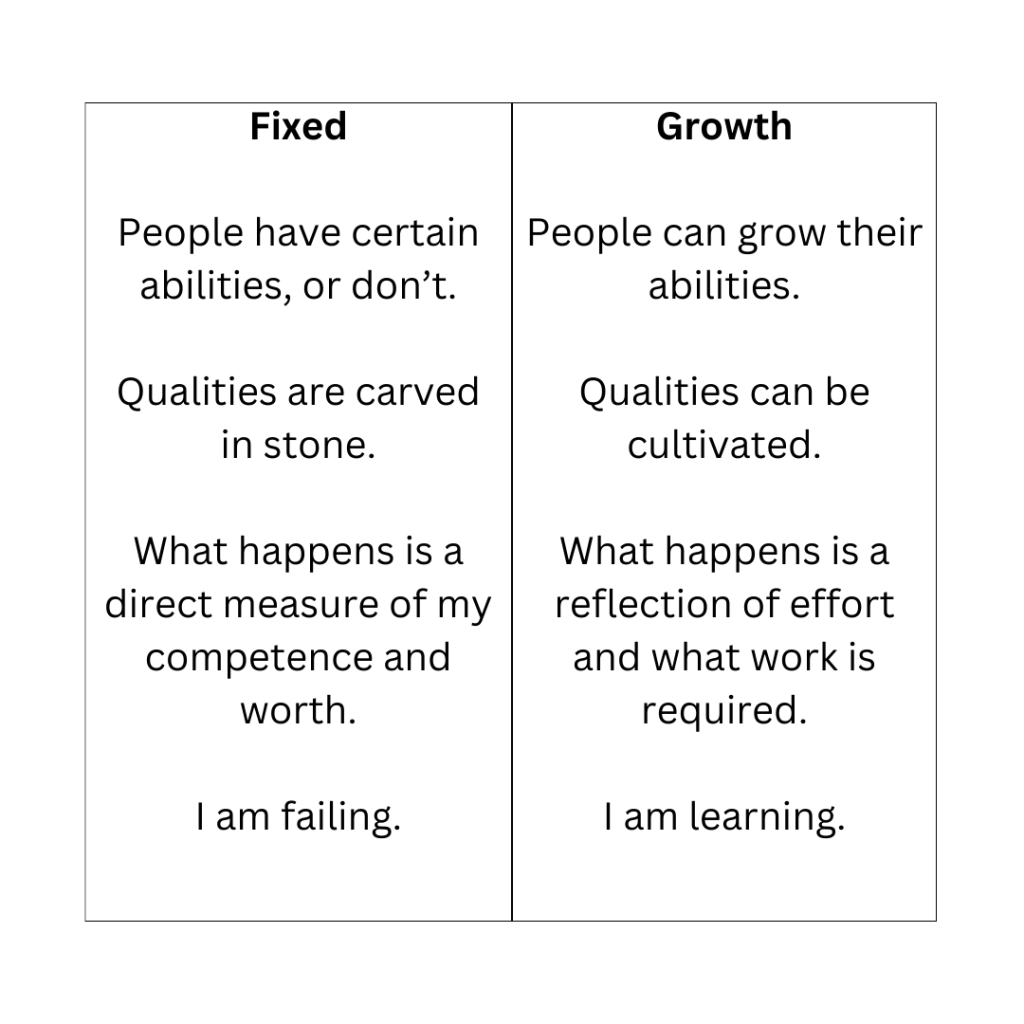
The fixed mindset is rigid and black-and-white. In this mindset we might think we can either do something or we can’t.
Whereas the growth mindset is more flexible. In this mindset we’d be more inclined to believe that we can learn and improve.
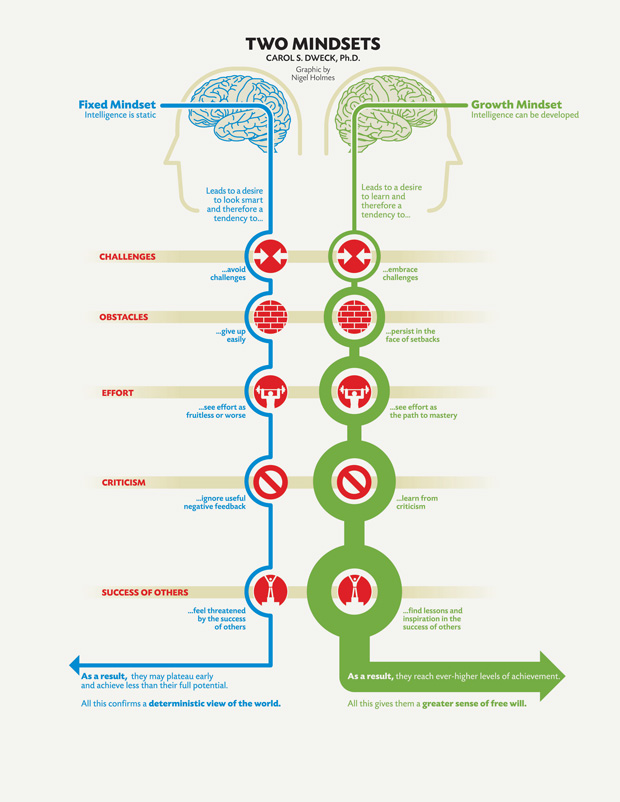
The fixed and the growth mindsets interact with key life components including how we view challenges, obstacles, effort, criticism, and the success of others, as shown in Carol Dweck’s diagram below:
Dweck explores these topics in the eight chapters and each chapter ends with “Grow Your Mindset,” which includes tips on how to apply the lessons from that chapter. The final chapter is dedicated to helping the reader cultivate a growth mindset.
My Key Takeaways
The fixed mindset is a barrier to change, development, and progress. The growth mindset is a starting point for change, but the work doesn’t stop here – “skills and achievement come through commitment and effort”.
In the chapter on Parents, teachers, and coaches, Dweck describes growth teachers who convey the message that there are no shortcuts, no magic, and no miracle workers.
These two takeaways really chime with my approach to therapy – while I understand why clients would like to magically feel better, it will take time, effort, and commitment to gain traction and momentum.
According to the research, “normal young children misbehave every three minutes”. Although this might bring a big sigh of relief to parents out there, there’s another message that comes with this: children pick up messages very early on about whether their behaviour and mistakes are “worthy of judgement and punishment or an occasion for suggestions and teaching”. It might be worth considering which message you’re conveying and how this could be tailored to, not just your children, but anyone you have a relationship with.
Although children love receiving praise about intelligence and talent, Dweck cautions that, “Praising children’s intelligence harms their motivation, and it harms their performance”. This is because if success equals intelligence, then failure equals stupidity, and this is the fixed mindset. Instead, praising the effort, process, and learning leads to longer-term confidence and a growth mindset.
On the other side of the coin is criticism. Children require honest, constructive criticism to learn and grow. Dweck tells us that even though we often just want to protect our children from criticism, not providing effective constructive criticism can lead to a lack of confidence, which can have far-reaching repercussions into their future. Constructive criticism should not be conflated with judgement. Constructive criticism involves helping people to become better.
“Change can be tough, but I’ve never heard anyone say it wasn’t worth it.”
Mindset, Carol Dweck
The biggest takeaway for me was stated in the first chapter, “The message is: you can change your mindset” which resonated fully with me in the four-step process in the final chapter which Dweck calls “the journey to a growth mindset”. The four steps involve acceptance, trigger-awareness, persona creation, and testing, with a fifth step being maintenance. Dweck expertly navigates any resistance in the reader by explaining that we all have a fixed mindset in some areas of our lives and that it’s just part of being human.
How Mindset by Carol Dweck relates to the work done in therapy
The aim of the book aligns with the principles of Cognitive Behavioural Therapy because the premise of CBT is that we hold beliefs about ourselves, other people, and the world which shape our thoughts and actions.
Having negative beliefs leads to unhelpful thoughts and behaviours, meaning that we can find ourselves stuck in vicious cycles that take us away from our desired outcome and can even inadvertently confirm our negative beliefs.
Below is one of Dweck’s descriptions of the growth and fixed mindsets responding to an academic failure, which I have transferred into a CBT model:

We can see that although the feeling of disappointment is present in both mindsets, the growth mindset leads to helpful thoughts and more effort, whereas the fixed mindset leads to unhelpful thoughts and avoidant behaviour.
Our interpretations inform our behaviour. If we can get our mindset in check, more productive and effective behaviours will follow.
In therapy we explore what the beliefs are, where they came from, as well as how to create new beliefs, thoughts, and actions that serve us better.
Should you read it?
I would absolutely recommend you read Mindset by Carol Dweck for yourself and use the four-step process in the final chapter to work on your own mindset.
After reading this book, I felt motivated and inspired to view challenges as learning opportunities, it’s already made a big difference in some key areas of my own life.
For anyone interested in continuing their learning, Dweck has provided a list of recommended books at the end which I reckon I’ll be working my way through because after reading her work, I truly trust her judgement.
Have a read and let me know how you get on!


 Therapy with Kirsty