After an amazing holiday, I’m delighted to be back to business and ready to work with my wonderful clients!
If you’re waiting on an email from me, please know that I’m working as quickly as possible to catch up and get back to you.

After an amazing holiday, I’m delighted to be back to business and ready to work with my wonderful clients!
If you’re waiting on an email from me, please know that I’m working as quickly as possible to catch up and get back to you.
I’m out of the office until May 30th and will pick up any emails on my return.
If you are in crisis or are contemplating suicide, please talk to someone you know or contact one of the organisations below:
Samaritans: 116 123
Breathing Space: 0800 838587
Perhaps the word ‘goals’ is enough is to make your body tighten up or to make your heart race or to make your hands feel sweaty.
But stay with me!
Goals are important in therapy so that we both know what we’re working on and to ensure that what we’re working on matters to you.
Setting goals is like setting a sat-nav to help you on your way to your destination.
In therapy, people tend to know what they DON’T want:
So, when it comes time to set goals, quite often it’s tempting to make variations of that:
These might sound reasonable, but it’s hard to know if and when the goals have been achieved.
What do they really mean? And what do they really mean to YOU?
That’s what we need to know.
To bring the goals to life and make them more actionable, we need to make them SMART.
SMART goals are specific, measurable, achievable, realistic and relevant, and time managed:
Specific: I will do A thing.
Measurable: I will do A thing B times.
Achievable: I will do A thing B times with C resources.
Realistic & Relevant: I will do A thing B times with C resources so that D thing occurs.
Time-bound: I will do A thing B times with C resources in D way by E time.
To do this, start with your aim: I want to be less anxious.
Then ask yourself, what specifically would I do differently if I felt less anxious?
The answer could be: I would go to the gym class I’d been scared to try.
How many times would I go: I’d go to the gym class once per week.
How possible is this: I have a gym membership, a pair of trainers, and time available to go to the gym class once per week.
How relevant: Going to the gym class once per week is relevant to me because I care about my health, and I know that exercise is good for taking care of health and combatting anxiety and would provide a sense of enjoyment and connection.
When will this happen: I’ll start going to the gym class this week and I’ll maintain it every week for at least 1 month.
So there we have it, we’ve transformed the broad aim of feeling less anxious into an actionable SMART goal.
SMART goals fill in the blanks: ‘If I felt X, then Y would change’.
Here are some examples of more SMART goals:
Perhaps what would change for you is reading, meditation, a new sport or hobby, arts and crafts, putting yourself forward for promotion, speaking in meetings, wearing new outfits, changing career, trying dating apps, arranging social events, telling people how you feel.
What would change for you?
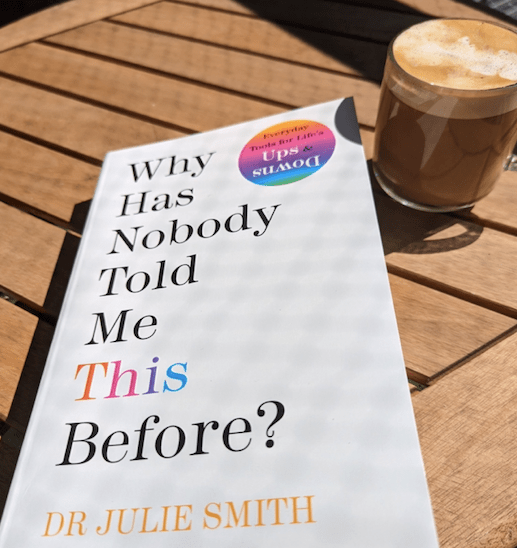
April’s book review is Why has nobody told me this before? by Dr Julie Smith which aims to deliver a ‘part journal, part guide’ for understanding more about what it is to be human and what can help us navigate different aspects of our experience.
The book is split into eight sections and covers low mood, motivation, emotional pain, grief, self-doubt, fear, stress, and creating a meaningful life.
And at the back you can find references, resources, and spare tools to help you on your onward journey.
The book comprises of top tips, suggested exercises, formulations, and specific psychological terminology which Smith explains in an accessible way.
I like that the reader can pick a topic from the content list that feels most relevant and jump in at that point, you don’t need to read the book from start to finish.
Another strength of the book is the inclusion of physical exercise as a key aspect of looking after mental health. I think this topic can be generally shied away from as clinicians sometimes think they need to stay in their ‘mental health lane’. But our brains are part of our bodies, so we need to start viewing them as connected and have open stigma-free conversations about exercise that are not aesthetically based.
The final positive I’d like to highlight is Smith’s use of images which really drive her points home. She refers to the weaves of a basket, a man on the floor, and an artist observing his painting. These images are so easy for the reader to quickly call to mind which supports the learning process.
My main critique of this book is that within the section on self-doubt, there is a sub-heading – why you don’t need to work on your self-esteem – under which Smith describes self-esteem as ‘psychological rent that you can never stop paying’.
Although self-esteem isn’t a recognised ‘disorder’ in the Diagnostic Statical Manual (DSM-5) in the same way that other depression and anxiety presentations are, it is recognised in the manual as a key symptom of depression.
Furthermore, CBT pioneer, Dr Melanie Fennell designed an evidence-based CBT treatment protocol aimed specifically at self-esteem which is widely accepted and used within the field of psychotherapy and goes way beyond just writing positive affirmations as Smith appears to suggest.
Self-esteem can absolutely be treated and improved through CBT.
My second critique is Smith’s differentiation between stress and anxiety within the section on stress.
Smith describes what anxious experiences involve, ‘feelings of fear and excessive worry thoughts’. However, it’s not made clear how stress differs from anxiety as it’s described in the book as alertness and a fight or flight response in the brain which also occurs with anxiety. It would have been helpful for these to be explained more clearly, perhaps with a basic table to outline similarities and differences.
Despite Smith saying at the outset of the book that, ‘this book is not therapy in the same way that a book about how to maximise your physical health is not medicine’, I would argue that this book does get pretty close to therapy in a book with the accessible language and terminology, clear formulations, and exercises and the firm and fair tone used throughout.
I would recommend the book to anyone who is interested in learning some fundamental psychological concepts, frameworks, and tools that can help with daily living. The book may be particularly helpful for those who cannot afford therapy.
I have the privilege of being allowed into my clients’ worlds and it’s a real joy to reach an ending in therapy when the client feels ready to take on their next steps without me.
*Here’s what a recent client had to say about working with me:
“As a male I always found the thought of therapy quite challenging and believed that the anxiety and depression that I was feeling at the time was something that I had to handle alone.
However once my mental health began to effect my ability to perform at my job I realised that something had to be done.
Kirsty very quickly put me at ease and helped cultivate an environment that felt safe and non-judgemental.
She is an empathetic listener who has the ability to make you feel like you’re speaking to a trusted friend or family member and is keen to get to the route cause of whatever difficulty you are trying to overcome.
From the experience I have taken away real life skills that have helped me not only perform better at work, but have also improved many of my personal relationships immeasurably.
I’d highly recommend Kirsty to anyone that is either struggling or is looking to make improvements to their mental health.
This is due to her professionalism, ability to hold you accountable for your behaviours and actions and her knowledge of CBT which she delivers in an incredibly accessible manner.
At the end of the process I feel like I’ve not only gained techniques and skills that will help me get through any tough patches to come but also a trusted friend who I know will be available again if needed.”
*This statement was provided knowing that it would be shared on my website and socials and is therefore shared with the consent of the client.
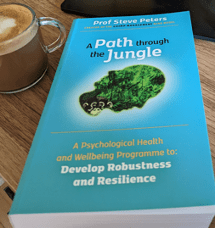
This month’s review is Professor Steve Peters’ second adult book, A path through the jungle.
Peters returns to build on his previous conceptual framework of the Chimp, the Human, and the Computer functions of the brain (see February book review for more) in this new programme which is designed to help the reader ‘develop robustness and resilience’.
This book continues in Peters’ direct yet reassuring tone, uses clear explanations and diagrams throughout, and follows a well-defined structure by dividing the book into 8 Stages comprising of 2-4 Units each.
The key difference between this and his previous book is that this one provides neuroscientific information and references to support his concepts so it’s ideal for anyone looking to really understand what’s happening from a neurological perspective.
Consequently, there are scientific terms used throughout such as amygdala, hypothalamus, and prefrontal cortex.
If this really isn’t your thing and you only want to understand how your Chimp, Human, and Computer are working together – or against each other – on a day-to-day basis then you could stick with Peters’ first book. However, Peters provides clear definitions and explanations so it could be worth dipping your toe!
One of the main strengths of A path through the jungle is the clarity with which Peters writes both in terms of content and structure.
Clarity teamed with distinct colours and boxes bring different aspects to the reader’s attention which is an effective way to keep the content stimulating, not always easy with neuroscience!
Within the 8 stages are units which all follow the same format which creates a safe predictability for the reader.
Each unit starts with a short comment which sets expectations, informative descriptions and illustrations, written examples to help the reader understand the translation of theoretical content into practice, scientific points, reminders, and exercises which are all centred on reinforcing the learning objective of the unit.
My only critique is that this book doesn’t really tell the reader anything new if you’ve already read The chimp paradox as this book mainly builds on the Chimp, Human, and Computer constructs with the support of scientific evidence.
So, although I would recommend this book, I’d say you could choose between The chimp paradox and A path through the jungle depending on whether or not you’d like the scientific information.
I’m delighted to say that I am able to offer new slots on Mondays at the following times:
Get in touch to arrange your first CBT appointment with me, kirsty.cbt@gmail.com.

Oh, I come from a long line of worriers!
I’ve always been a worrier.
If I didn’t worry, then I’d worry about not being worried.
These are just some of the phrases I hear from clients when they speak about worrying.
We can all worry from time-to-time. But what-if worriers or people who have generalised anxiety disorder tend to have a frequent or constant feeling of anxiety and dread and can worry disproportionately about everyday things.
The subject of the worry tends to change e.g., worrying about health for a while, then worrying about finances, then worrying about career and so on.
What-if worriers worry about possible outcomes, regardless of how likely or unlikely it is that the worry would happen:
People who aren’t consumed by these worries might view the what-if worrier as irrational, or have a hard time empathising with them; they’ll simply think ‘well that won’t happen’, and move on with their day.
But for the what-if worrier, it can be exhausting and debilitating to consider possible outcomes, try to plan accordingly, and make appropriate decisions.
The symptoms of this type of worry can vary from person to person but can include:
With what-if worries, we don’t need to go down the rabbit hole of discussing each worry in detail; even if we solve a worry, there’ll always be another one coming down the tracks.
Instead, it can be more helpful to consider what purpose the worrying is serving in your life and then take steps to consider the benefits and costs of living in this way.
The 5 most common internalised reasons for worrying are:
Underlying each of these reasons, is an intolerance of uncertainty and a need to find control.
Once you’ve established your reason, you can write out the benefits and costs.
A short example: If I worry about the worst, then I’ll be prepared.
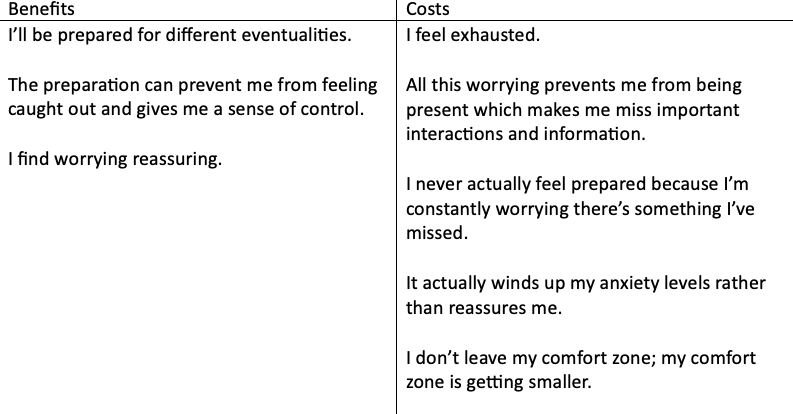
Write down all your benefits and costs and consider if you were to put the lists on a set of scales, which list weighs the most?
Now we need to challenge the worry.
Each of the following steps can seem tricky, but try to be firm with yourself, you can do it!
With worrying, we want to control the controllables and let go of the rest. This tends to be easier said than done but consistent practice will go a long way!
Remember, worrying is normal and natural and impossible to stop completely.
The purpose is not to stop you from worrying, it’s about being able to manage and cope with worries and self-soothe.
A therapist can help you work through this if you’re still struggling.
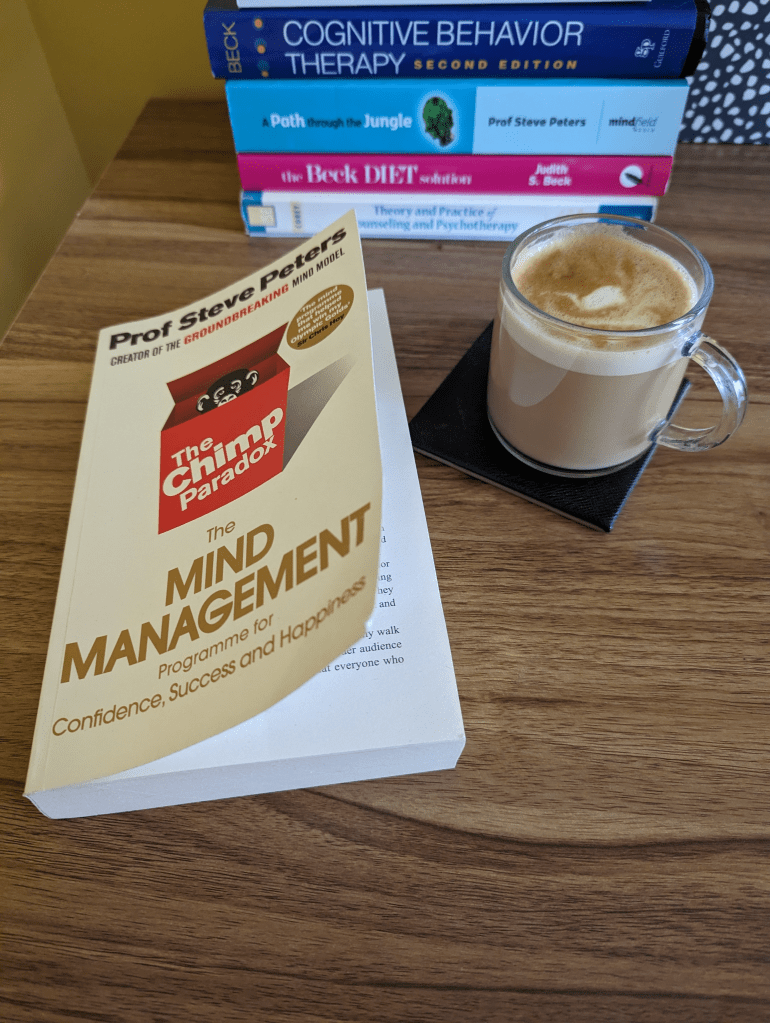
February’s book review is The Chimp Paradox by Prof Steve Peters.
A key aim of the book is to minimise psychological and behavioural dysfunction by taking the reader on a journey through the ‘psychological universe’ which involves understanding yourself, understanding others, communicating effectively, living in your world, maintaining your health, being successful, and being happy.
The book is divided into three parts:
Part one’s information on how the mind works in the context of the human, the chimp, and the computer provides the reader with a solid foundation of the inner workings of the mind.
Part two extends the education to understanding and communicating effectively with others and creating suitable environments for dealing with stress (both immediate and long-term stress).
Part three moves the reader towards future planning by outlining how to set up for success in terms of physical and mental health, maintaining progress and dealing with setbacks, leaning on others for support, and developing confidence and happiness through positive mindset.
Peters describes the chimp paradox as a simplified version of our brain; an easy working model comprising of three parts – the human, the chimp, and the computer – which manifest in our thinking and behavioural patterns.
It is acknowledged at the outset that the brain is much more complicated than this model and has many functions which aren’t covered in this book; the purpose is to give the reader information that can be easily transferred into actionable steps.
The human and chimp aspects represent the frontal (rational and logical) and limbic (emotional) systems in the brain respectively and the computer represents the brain’s information storage system which we use as a sense-checker before acting.
Peters describes the problem that we find ourselves in with our human and chimp modes as having two beings who try to work together but as they have different ‘personalities’ and agendas, they can clash and leave us tied in knots or acting erratically.
The imagery of the human, the chimp, and the computer is an incredibly quick and effective way to stop and check in with ourselves:
Once we’ve answered these questions we can CHOOSE how to act.
The use of case studies and examples throughout supports the information, and each chapter has suggested exercises which help the reader consolidate learning and consider how it can be applied.
Peters provides helpful definitions which differentiate between concepts such as hurdles, barriers, and pitfalls, and goals and dreams, and expertly manages to strike a balance between delivering clear information and diagrams in a simple and concise manner without being patronising or condescending to the reader.
Peters’ tone enables the reader to be self-compassionate by removing the fault or blame of certain reactions from the reader and redirecting it towards the inner chimp.
This isn’t to say that Peters wants the reader to stop taking responsibility, quite the opposite in fact!
Peters reminds the reader throughout that we are in control and have a choice on how to act and if the chimp gets the better of us it’s our job to correct the mistake and apologise where necessary.
The Chimp Paradox is an easy-to-understand approach to complex brain science which makes it an ideal read for anyone interested in learning more about the how the human mind works and how to manage it effectively; I’d highly recommend it!
Look out for my Path Through the Jungle review in March which is the second adult book by Prof Steve Peters.
I welcome you into the Zoom room.
I say hello, check I can hear and see you and you can see and hear me.
I tell you about the confidentiality conditions.
You will have had the opportunity to read over the confidentiality policy ahead of the session as I send it to you by email before we begin. This is just a chance for me to remind you that everything will be confidential between ourselves unless there is a serious or imminent risk to either yourself, another person, a child, or if any criminal activity was disclosed.
I set an agenda and ask if you want to cover anything I’ve not mentioned.
It’s quite natural for you to not have anything to add to the agenda in week one, a lot of people are happy to take my lead. But if you do have something, feel free to add away! The reason an agenda is set is so that you know at the beginning what to expect, there’ll be no hidden surprises. Although the agenda is set in the beginning, things can be added later if something pops up or you forgot at the beginning.
I ask you to tell me what brings you along, what’s happening in your world, and what you’d like to work on.
This is where you get the chance to explain a bit about what it’s like to be you right now. I’ll guide you by asking what you think, how you cope, and how you feel about things. Try not to worry about getting stuck or not knowing what to say; it’s my job to help you find the words. I’ll ask you what it is that you want to work towards, this is also known as therapy goals.
I’ll summarise what you said to make sure I’m hearing you right.
I’ll repeat back to you what I’ve heard either using your own words or a paraphrased version and you’ll be able to confirm if that’s right, if there’s something I’ve missed or misheard, or anything else you’d like to change or add. This helps me to make sure that I’m on your page and can reassure you that I’m really hearing your perspective.
I’ll explain exactly what I offer and what you can broadly expect.
I’ll give you an overview of CBT, how I work, what the expectations are of-and-for you, and how we’ll work together. You can ask any questions you might have, some commonly asked questions can be found here: https://therapywithkirsty.co.uk/faqs/
We can decide on an actionable step for you to take away.
In CBT we call this ‘homework’. It’s not the same as school – I’m not your teacher, I’m not assessing you, you don’t need to feel guilty if you don’t do it. The aim of the homework is to help you move forward, so it’s completely up to you whether or not you commit to it. We have 168 hours in a week, we’re together for 1, so it’s something you can do outside of our session to continue helping yourself along.
We book in our next appointment.
Appointments are usually on the same day, at the same time each week but we can firm this up as I appreciate that sometimes life gets in the way.
And that’s it!
You’ve just completed your first therapy session! That wasn’t so bad, was it?

 Therapy with Kirsty