The collab you didn’t know you needed to end 2024 strong in your mind and body!
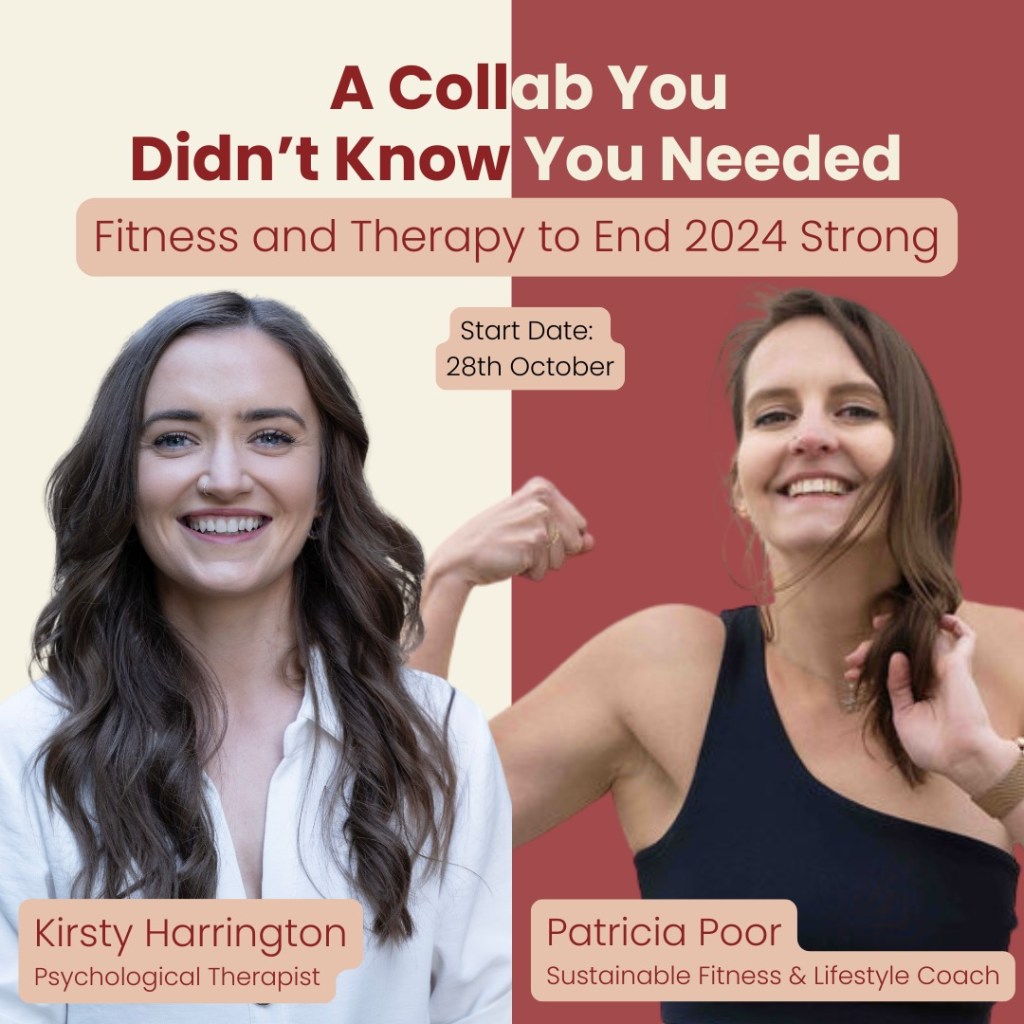
If you follow me on LinkedIn, you might have already seen this exciting news – Fitness Coach Patricia Poor and I are bringing together our expertise in psychotherapy and fitness to help you end 2024 strong, in your mind and in your body 🧠 💪
We know that these coming weeks can be challenging – the cold and dark nights that impact moods and routines, the stress that builds as we move into holiday season.
Rather than just getting through to the end of year, what if you could feel at your best? 💫
We have designed this program to help you:
💪 Confidently create consistency 🧠 Manage holiday stress ⚖️ Cultivate balance in the mind and body ✨ Break free from all-or-nothing thoughts and behaviours
We only have 4 spaces available for this program as we believe in giving you our best effort, time, and attention so we can help you end this year strong.
💥 The full 6-week program – 6 therapy sessions + personalised workouts + fitness coaching – is just £599 💥
🐣 And if you sign up before October 21st, you’ll get a bonus call with me and Pat.
Let’s finish 2024 together 💫
Send me an email for information and to get started!
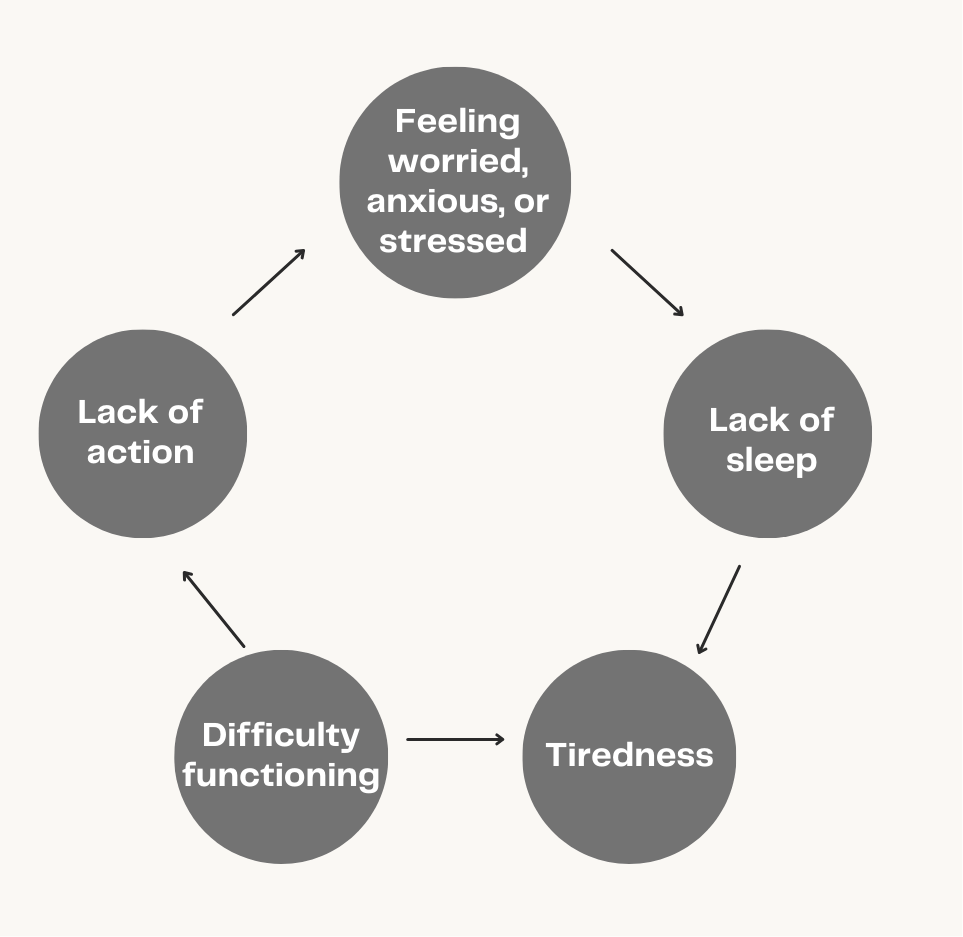
Sleep and mental health have a reciprocal relationship; our mental health can impact our sleep quality and poor sleep can impact our mental health and wellbeing as illustrated in the vicious cycle below:
Read on for my Top Ten Tips for improving your chances of a better sleep!
Environment Make your room somewhere you want to relax and sleep.
Do this by tidying your room and keeping the bedroom for sleep and sex only. Avoid eating, drinking, or watching tv in your sleep space.
Routine Try to stick to a bedtime and a wake time and avoid snoozing through the day.
This can feel tricky but sticking with it can help regulate your circadian rhythm meaning your mind and body are programmed for sleep.
Caffeine and sugar Avoid caffeine or high sugar food or drinks prior to bed.
Usual caffeine suspects are coffee, tea, energy drinks, and chocolate. I’m not necessarily asking you to give them up forever, just while we’re sorting your sleep out!
Swap the screens Reduce or avoid screen time where possible before bed. The blue lights from the screens keep our brains awake and sometimes the content puts our brains on high alert, particularly watching the news or high action movies.
Pick up a book instead – our eyes moving left to right across the page helps induce sleep.
Too many to-dos or should-have-dones? Write down those thoughts that swim round and round in your mind.
Getting them out of your mind and onto the page means that you can go to sleep safe in the knowledge that your thoughts won’t be forgotten.
2-4 Breathing Inhale for the count of 2, and exhale for the count of 4. Extending the exhale relaxes the mind and body, taking our nervous system to the “rest and digest” state.
It’s normal for the mind to wander off, return your focus to your breath.
Avoid the countdown “If I fall asleep now I’ll get 7 hours… oh no, now I’ll only get 6 hours…”
Instead remind yourself that sleep is a fundamental need of the body, you will manage to sleep, and even simply resting the body, mind, and eyes is worthwhile.
Block out the light Eye masks can be helpful for blocking out light and signalling to the brain that it’s time to sleep – no more staring at the ceiling!
Eye masks are inexpensive and come in a range of colours and materials so you can find what works for you.
Relaxing sounds Listening to ocean sounds, forest sounds, rain drops, or guided sleep meditations can be a helpful distraction if thoughts are still circulating in your mind.
There’s loads to choose from on youtube, so if one doesn’t work either try it again or try a different audio.
Natural remedies Drinking “Sleepy Tea” or “Night Time Tea” can be helpful as they typically contain ingredients like lavender and camomile which promote a calm state.
Avoid drinking too close to bed time as you’ll likely be up through the night for the toilet! I’d recommend at least an hour prior to bed.
There you have it! Have a go at incorporating these tips into your routine for a couple of weeks to see how it impacts your sleep ability and quality and let me know how you get on.
If you’re struggling to establish a sleep routine or those pesky racing thoughts stick around, I could help you in 1-1 therapy by processing your stress, worry, or anxiety and tailoring the information specifically to you and your circumstances. Drop me an email to get started.
Take a deep breath. We’ve all heard that, right? Perhaps before a job interview, a driving test, or when feeling angry or upset. But does breathing really make a difference?
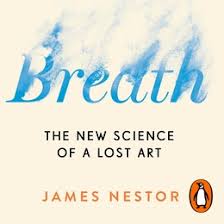
James Nestor certainly thinks so, and he shares his experience and perspective in his compelling book, “Breath – The new science of a lost art” in which he discovers that by making slight changes to our breathing we can:
Jump-start athletic performance
Rejuvenate internal organs
Halt snoring, allergies, asthma, and auto immune disease
Straighten scoliotic spines
With such big claims being made, there’s been a lot of hype in the health and wellness space about this book, so I grabbed myself a copy to see what all the fuss was about.
Read on to find out if you should follow the crowd too!
In this review of Breath by James Nestor, I’m bringing you:
Intro to the author and the book
My key takeaways
How breathing relates to your mental health
Should you read it
Breath, James Nestor
James Nestor is a science journalist, a role which involves conveying science to the masses. If you understand the climate crisis, AI developments, or Covid19, that’s likely thanks to people like James Nestor translating all the science jargon.
A doctor-recommended breathing class transformed Nestor from being emotionally and physically ill to calm, quiet, and rested. He becomes driven to know what happened to him in that class and how, and so begins Breath.
The book is split into 3 parts that take us back through time and across the world as Nestor rediscovers various breathing techniques with the help of breath pioneers who he calls”pulmonauts”:
Part One – The experiment
Part Two – The lost art and science of breathing
Part Three – Breathing+
Nestor includes an ample Appendix full of breathing techniques for the reader to try out and he sign posts his website for video tutorials too.
My key takeaways
I was struck by how many common conditions and problems breathing is connected to:
ADHD, anxiety, and depression
Asthma, allergies, blood pressure issue, and COPD
Bronchitis, lung capacity issues, and pneumonia
Headaches, migraines, and scoliosis
Insomnia, sleep apnoea, and snoring
Being overweight, having skin conditions, and sexual dysfunction
Excessive thirst and peeing in the night
“Our ability to breathe full breaths was literally a measure of living capacity”
Contrary to popular belief, lung capacity out-ranks genetics, diet, and exercise as the greatest predictor of life span. Thankfully, we aren’t doomed by our current lung capacity as internal organs are malleable, meaning that we can work on our lung capacity at any age.
A simple takeaway – but one that really landed with me – was to close your mouth when you breathe. I won’t say too much on this as it’s the focus of “the experiment” in Part One of the book; Nestor compels the reader to make this simple change by detailing his gruelling breathing experiments.
My biggest takeaway from is an increased awareness of my own breath – whether my breath is reaching my belly or getting stuck in my chest; if I’m sleeping with my mouth closed; if I can continue to breathe through my nose while exercising. This awareness now naturally flows to a self-scan in which I notice how I’m feeling, if I’m holding any tension anywhere, if anything needs tended to. In short, it’s increased my ability to self-regulate.
Breathing for your mental health
One of the key links between breath and mental health is the body’s control system – the autonomic nervous system – containing two opposing nervous systems – the parasympathetic and the sympathetic.
The parasympathetic nervous system is responsible for the rest and relax state and is sometimes called the “feed and breed” or “rest and digest” system.
On the other hand, when we’re feeling stressed or anxious, the sympathetic nervous system kicks into action, you might have heard of this as the “fight or flight” response. This system makes us alert and “meaner and leaner” so we can deal with danger.
We activate these systems when we breathe. Inhaling activates the alert sympathetic system; exhaling takes us to the relaxed parasympathetic system. Extending the exhale longer than the inhale helps take us to a relaxed state, an example of this being to inhale for the count of 2 and exhale for the count of 4. Personally, I find this technique helpful for falling asleep.
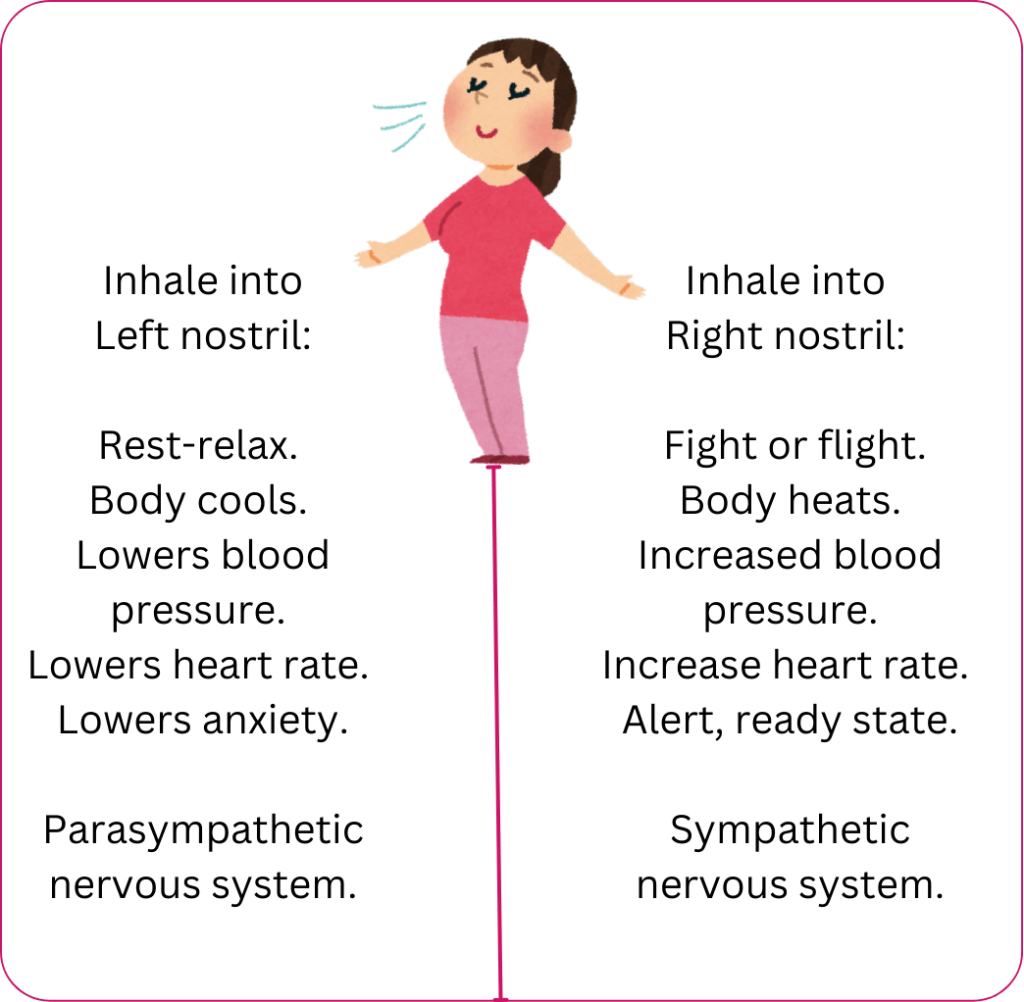
Nestor provides an overview of how breathing interacts with the two systems which I’ve outlined here:
A breathing technique that enables inhaling into each nostril is “alternate nostril breathing” (aka nadi shodana) which can be found in Nestor’s Appendix. This technique involves using the thumb and ring finger to hold and release nostrils to control air flow and is particularly helpful for reducing stress for example prior to a meeting, an event, or sleep.
Breathing techniques could be a key tool for managing psychological issues including ADHD, anxiety, depression, insomnia, and panic as we can develop control over which state we activate and when.
The important thing to remember with any breathing technique is to keep practicing! Often I hear people say “I tried a breathing exercise once but it didn’t work” or “I was too distracted”. Even though we breathe all the time, these techniques are a new skill that will require time, effort, and practice. If (and when) distraction sneaks in, gently guide the mind back to focusing on the breath.
Should you read it
This is an interesting read that goes back through history and across cultures to bring “forgotten” knowledge of the breath to a new audience and in the process brings self-awareness and breathing techniques to the reader.
My main critique is that the title suggests that Nestor is bringing us “new science” about the breath, but what we get is mainly anecdotes and personal experiments from an excellent storyteller.
I’d recommend this book if you’re struggling with any of the physical or psychological health issues mentioned throughout this review and want to try some of the techniques to support your health and wellbeing, or you want to improve your lung capacity to increase your life span.
 Therapy with Kirsty