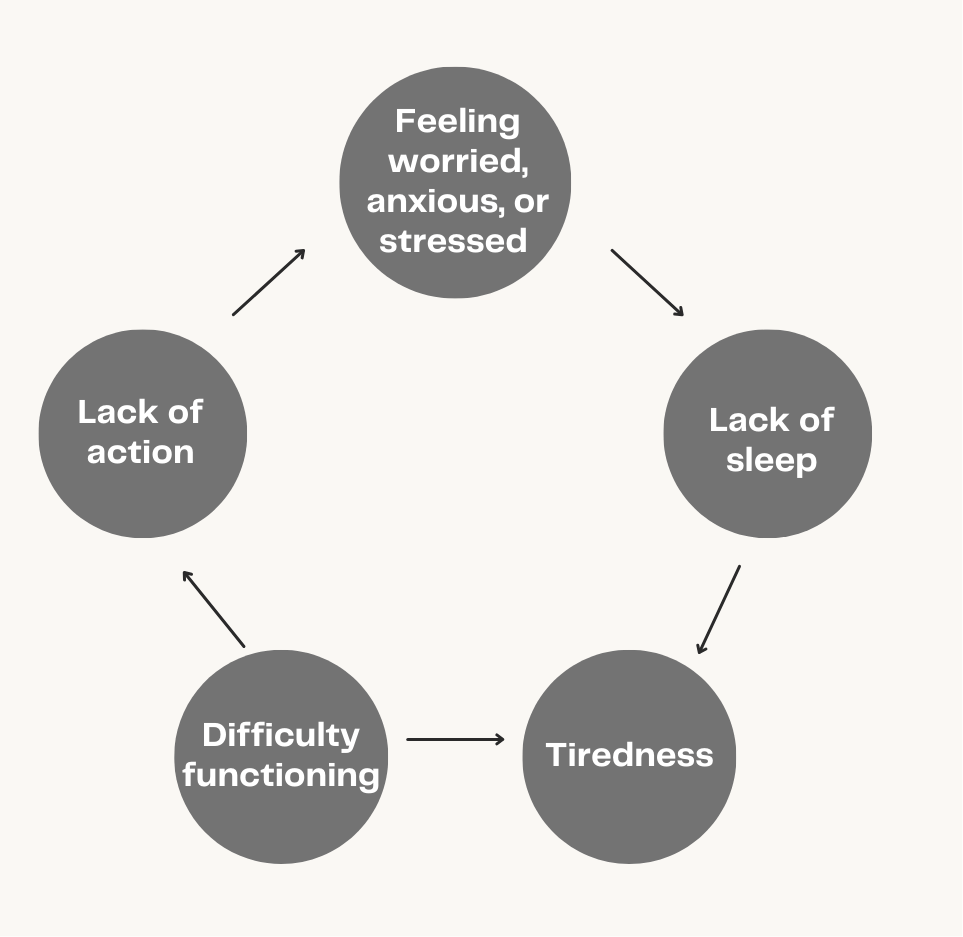
Sleep and mental health have a reciprocal relationship; our mental health can impact our sleep quality and poor sleep can impact our mental health and wellbeing as illustrated in the vicious cycle below:
Read on for my Top Ten Tips for improving your chances of a better sleep!
- Environment
Make your room somewhere you want to relax and sleep.
Do this by tidying your room and keeping the bedroom for sleep and sex only. Avoid eating, drinking, or watching tv in your sleep space. - Routine
Try to stick to a bedtime and a wake time and avoid snoozing through the day.
This can feel tricky but sticking with it can help regulate your circadian rhythm meaning your mind and body are programmed for sleep. - Caffeine and sugar
Avoid caffeine or high sugar food or drinks prior to bed.
Usual caffeine suspects are coffee, tea, energy drinks, and chocolate. I’m not necessarily asking you to give them up forever, just while we’re sorting your sleep out! - Swap the screens
Reduce or avoid screen time where possible before bed. The blue lights from the screens keep our brains awake and sometimes the content puts our brains on high alert, particularly watching the news or high action movies.
Pick up a book instead – our eyes moving left to right across the page helps induce sleep. - Too many to-dos or should-have-dones?
Write down those thoughts that swim round and round in your mind.
Getting them out of your mind and onto the page means that you can go to sleep safe in the knowledge that your thoughts won’t be forgotten. - 2-4 Breathing
Inhale for the count of 2, and exhale for the count of 4. Extending the exhale relaxes the mind and body, taking our nervous system to the “rest and digest” state.
It’s normal for the mind to wander off, return your focus to your breath. - Avoid the countdown
“If I fall asleep now I’ll get 7 hours… oh no, now I’ll only get 6 hours…”
Instead remind yourself that sleep is a fundamental need of the body, you will manage to sleep, and even simply resting the body, mind, and eyes is worthwhile. - Block out the light
Eye masks can be helpful for blocking out light and signalling to the brain that it’s time to sleep – no more staring at the ceiling!
Eye masks are inexpensive and come in a range of colours and materials so you can find what works for you. - Relaxing sounds
Listening to ocean sounds, forest sounds, rain drops, or guided sleep meditations can be a helpful distraction if thoughts are still circulating in your mind.
There’s loads to choose from on youtube, so if one doesn’t work either try it again or try a different audio. - Natural remedies
Drinking “Sleepy Tea” or “Night Time Tea” can be helpful as they typically contain ingredients like lavender and camomile which promote a calm state.
Avoid drinking too close to bed time as you’ll likely be up through the night for the toilet! I’d recommend at least an hour prior to bed.
There you have it! Have a go at incorporating these tips into your routine for a couple of weeks to see how it impacts your sleep ability and quality and let me know how you get on.
If you’re struggling to establish a sleep routine or those pesky racing thoughts stick around, I could help you in 1-1 therapy by processing your stress, worry, or anxiety and tailoring the information specifically to you and your circumstances. Drop me an email to get started.
 Therapy with Kirsty