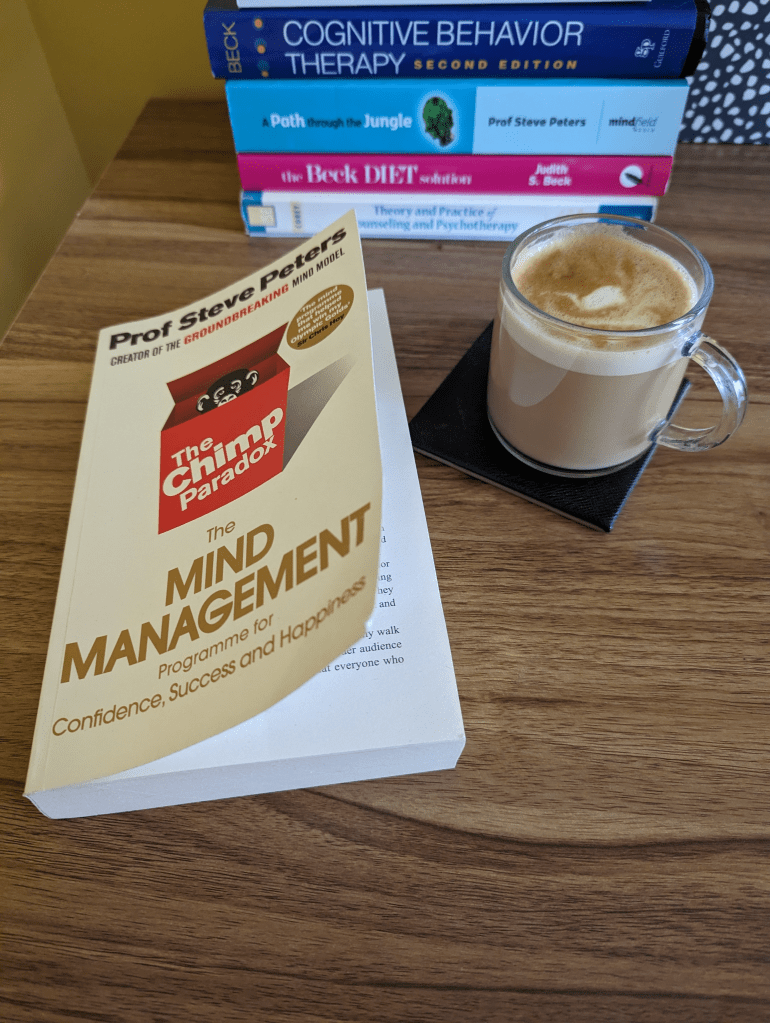
February’s book review is The Chimp Paradox by Prof Steve Peters.
A key aim of the book is to minimise psychological and behavioural dysfunction by taking the reader on a journey through the ‘psychological universe’ which involves understanding yourself, understanding others, communicating effectively, living in your world, maintaining your health, being successful, and being happy.
The book is divided into three parts:
- Your inner mind explored,
- Day-to-day functioning,
- Your health, success, and happiness.
Part one’s information on how the mind works in the context of the human, the chimp, and the computer provides the reader with a solid foundation of the inner workings of the mind.
Part two extends the education to understanding and communicating effectively with others and creating suitable environments for dealing with stress (both immediate and long-term stress).
Part three moves the reader towards future planning by outlining how to set up for success in terms of physical and mental health, maintaining progress and dealing with setbacks, leaning on others for support, and developing confidence and happiness through positive mindset.
Peters describes the chimp paradox as a simplified version of our brain; an easy working model comprising of three parts – the human, the chimp, and the computer – which manifest in our thinking and behavioural patterns.
It is acknowledged at the outset that the brain is much more complicated than this model and has many functions which aren’t covered in this book; the purpose is to give the reader information that can be easily transferred into actionable steps.
The human and chimp aspects represent the frontal (rational and logical) and limbic (emotional) systems in the brain respectively and the computer represents the brain’s information storage system which we use as a sense-checker before acting.
Peters describes the problem that we find ourselves in with our human and chimp modes as having two beings who try to work together but as they have different ‘personalities’ and agendas, they can clash and leave us tied in knots or acting erratically.
The imagery of the human, the chimp, and the computer is an incredibly quick and effective way to stop and check in with ourselves:
- Am I responding from a logical, rational place = human
- Am I responding from an emotional, instinctive place = chimp
- Do I need to update my frame of reference = computer
Once we’ve answered these questions we can CHOOSE how to act.
The use of case studies and examples throughout supports the information, and each chapter has suggested exercises which help the reader consolidate learning and consider how it can be applied.
Peters provides helpful definitions which differentiate between concepts such as hurdles, barriers, and pitfalls, and goals and dreams, and expertly manages to strike a balance between delivering clear information and diagrams in a simple and concise manner without being patronising or condescending to the reader.
Peters’ tone enables the reader to be self-compassionate by removing the fault or blame of certain reactions from the reader and redirecting it towards the inner chimp.
This isn’t to say that Peters wants the reader to stop taking responsibility, quite the opposite in fact!
Peters reminds the reader throughout that we are in control and have a choice on how to act and if the chimp gets the better of us it’s our job to correct the mistake and apologise where necessary.
The Chimp Paradox is an easy-to-understand approach to complex brain science which makes it an ideal read for anyone interested in learning more about the how the human mind works and how to manage it effectively; I’d highly recommend it!
Look out for my Path Through the Jungle review in March which is the second adult book by Prof Steve Peters.
 Therapy with Kirsty
2 replies on “February book review – The chimp paradox”
[…] conceptual framework of the Chimp, the Human, and the Computer functions of the brain (see February book review for more) in this new programme which is designed to help the reader ‘develop robustness and […]
LikeLike
[…] June book review – Gut Feelings April book review – Why has nobody told me this before? March book review – A path through the jungle February book review – The chimp paradox […]
LikeLike