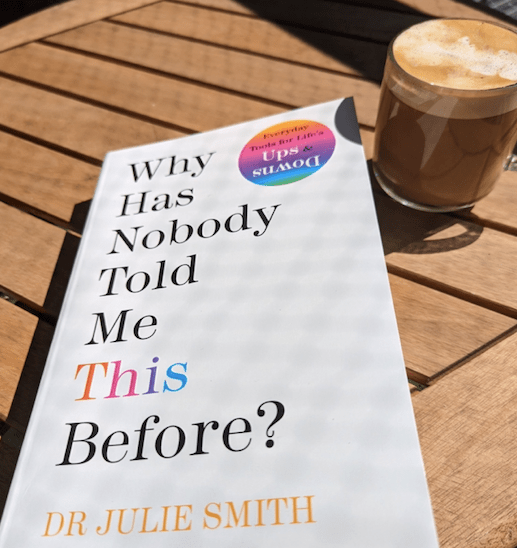
April’s book review is Why has nobody told me this before? by Dr Julie Smith which aims to deliver a ‘part journal, part guide’ for understanding more about what it is to be human and what can help us navigate different aspects of our experience.
The book is split into eight sections and covers low mood, motivation, emotional pain, grief, self-doubt, fear, stress, and creating a meaningful life.
And at the back you can find references, resources, and spare tools to help you on your onward journey.
The book comprises of top tips, suggested exercises, formulations, and specific psychological terminology which Smith explains in an accessible way.
I like that the reader can pick a topic from the content list that feels most relevant and jump in at that point, you don’t need to read the book from start to finish.
Another strength of the book is the inclusion of physical exercise as a key aspect of looking after mental health. I think this topic can be generally shied away from as clinicians sometimes think they need to stay in their ‘mental health lane’. But our brains are part of our bodies, so we need to start viewing them as connected and have open stigma-free conversations about exercise that are not aesthetically based.
The final positive I’d like to highlight is Smith’s use of images which really drive her points home. She refers to the weaves of a basket, a man on the floor, and an artist observing his painting. These images are so easy for the reader to quickly call to mind which supports the learning process.
My main critique of this book is that within the section on self-doubt, there is a sub-heading – why you don’t need to work on your self-esteem – under which Smith describes self-esteem as ‘psychological rent that you can never stop paying’.
Although self-esteem isn’t a recognised ‘disorder’ in the Diagnostic Statical Manual (DSM-5) in the same way that other depression and anxiety presentations are, it is recognised in the manual as a key symptom of depression.
Furthermore, CBT pioneer, Dr Melanie Fennell designed an evidence-based CBT treatment protocol aimed specifically at self-esteem which is widely accepted and used within the field of psychotherapy and goes way beyond just writing positive affirmations as Smith appears to suggest.
Self-esteem can absolutely be treated and improved through CBT.
My second critique is Smith’s differentiation between stress and anxiety within the section on stress.
Smith describes what anxious experiences involve, ‘feelings of fear and excessive worry thoughts’. However, it’s not made clear how stress differs from anxiety as it’s described in the book as alertness and a fight or flight response in the brain which also occurs with anxiety. It would have been helpful for these to be explained more clearly, perhaps with a basic table to outline similarities and differences.
Despite Smith saying at the outset of the book that, ‘this book is not therapy in the same way that a book about how to maximise your physical health is not medicine’, I would argue that this book does get pretty close to therapy in a book with the accessible language and terminology, clear formulations, and exercises and the firm and fair tone used throughout.
I would recommend the book to anyone who is interested in learning some fundamental psychological concepts, frameworks, and tools that can help with daily living. The book may be particularly helpful for those who cannot afford therapy.
 Therapy with Kirsty
One reply on “April book review – Why has nobody told me this before? ”
[…] book review – Gut Feelings April book review – Why has nobody told me this before? March book review – A path through the jungle February book review – The […]
LikeLike