Categories
book-review

“You mean I don’t have to be dumb?” How to develop a growth mindset

There are some things you can do and others you can’t, right? Maybe it’s not so black-and-white.

“Mindset – Changing the way you think to fulfil your potential” by Dr Carol S. Dweck seeks to educate the reader on “how a simple belief about yourself permeates every part of your life”.

Dweck calls this belief a “mindset” and categorises into “fixed mindset” and “growth mindset”.

In this review of Mindset by Carol Dweck, I’ll cover:

  • An intro to the author
  • What is a fixed mindset
  • What is a growth mindset
  • My key takeaways 
  • How this book relates to the work done in therapy
  • And whether you should grab yourself a copy

Let’s get into it.

The Author

Carol Dweck is a professor at Stanford University and is one of the world’s leading researchers in personality, social psychology, and developmental psychology.

She uses her own research, anecdotes from her own life experience, and her work with her students, to illustrate how our mindset can have a big say in how we behave and interact with the world across various settings – arts and science, sport, business, education, and relationships. 

You can expect to find out how mindsets change:

  • What people strive for and what they see as success.
  • The definition, significance, and impact of failure.
  • The deepest meaning of effort.

So what are these mindsets? 

In essence, the mindsets are what we believe about ourselves in terms of our intelligence, competence, and talent. 

The fixed mindset is rigid and black-and-white. In this mindset we might think we can either do something or we can’t. 

Whereas the growth mindset is more flexible. In this mindset we’d be more inclined to believe that we can learn and improve.
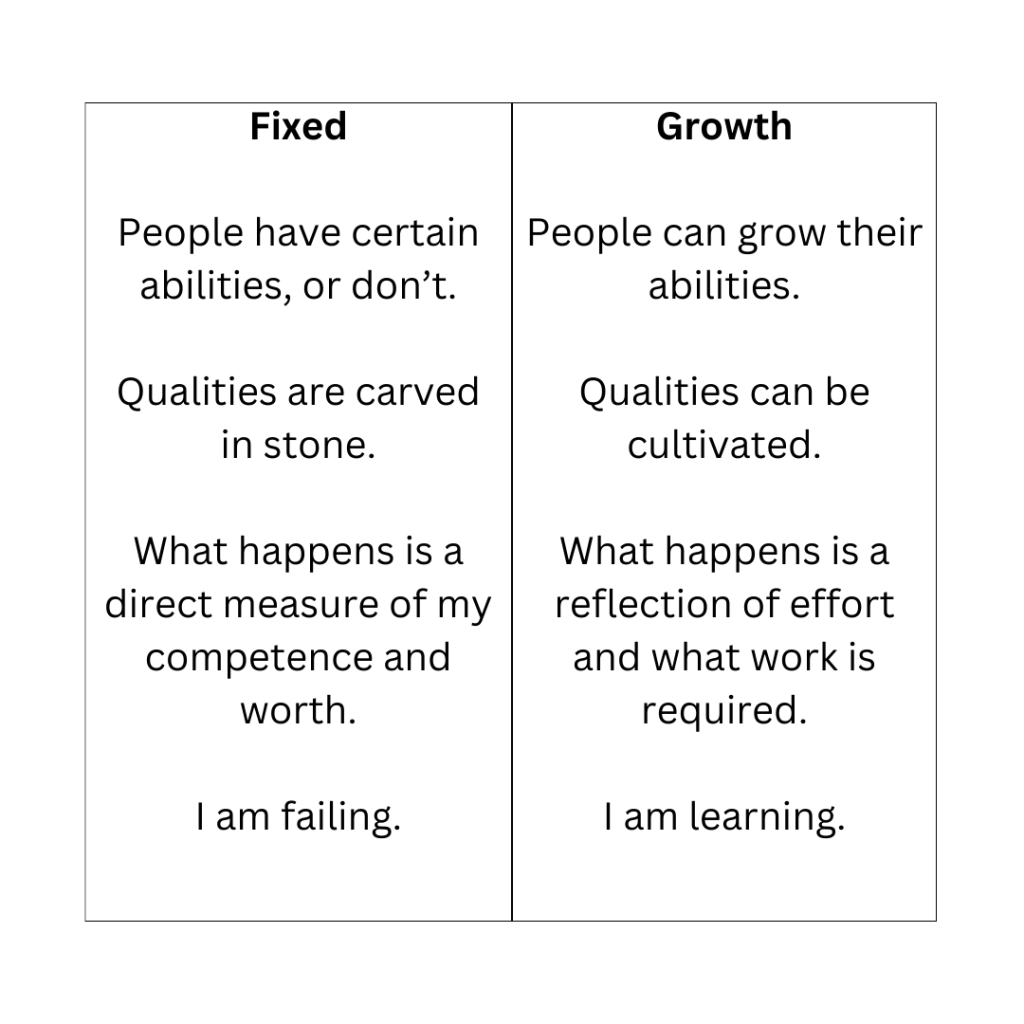
The fixed and the growth mindsets interact with key life components including how we view challenges, obstacles, effort, criticism, and the success of others, as shown in Carol Dweck’s diagram below:
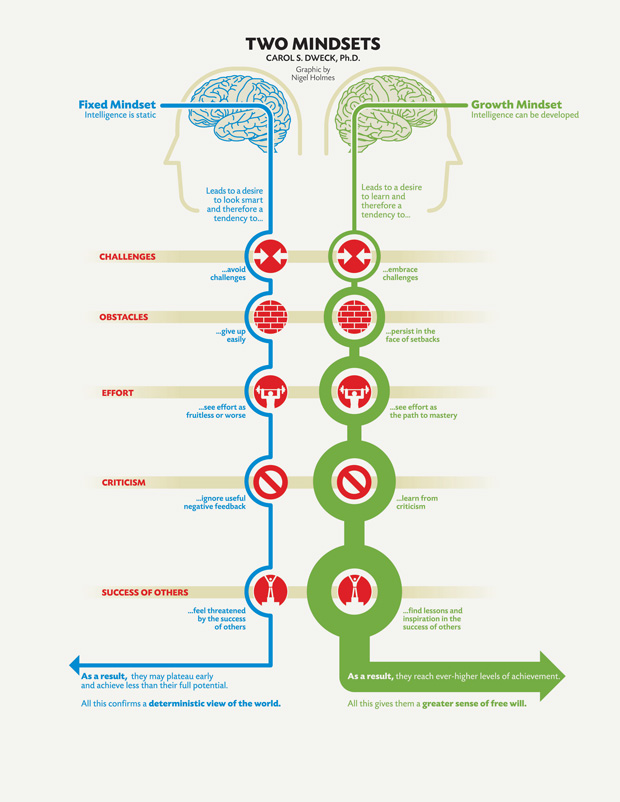
Mindset by Carol Dweck, Two Mindsets

Dweck explores these topics in the eight chapters and each chapter ends with “Grow Your Mindset,” which includes tips on how to apply the lessons from that chapter. The final chapter is dedicated to helping the reader cultivate a growth mindset.  

My Key Takeaways

The fixed mindset is a barrier to change, development, and progress. The growth mindset is a starting point for change, but the work doesn’t stop here – “skills and achievement come through commitment and effort”.

In the chapter on Parents, teachers, and coaches, Dweck describes growth teachers who convey the message that there are no shortcuts, no magic, and no miracle workers. 

These two takeaways really chime with my approach to therapy – while I understand why clients would like to magically feel better, it will take time, effort, and commitment to gain traction and momentum. 

According to the research, “normal young children misbehave every three minutes”. Although this might bring a big sigh of relief to parents out there, there’s another message that comes with this: children pick up messages very early on about whether their behaviour and mistakes are “worthy of judgement and punishment or an occasion for suggestions and teaching”. It might be worth considering which message you’re conveying and how this could be tailored to, not just your children, but anyone you have a relationship with. 

Although children love receiving praise about intelligence and talent, Dweck cautions that, “Praising children’s intelligence harms their motivation, and it harms their performance”. This is because if success equals intelligence, then failure equals stupidity, and this is the fixed mindset. Instead, praising the effort, process, and learning leads to longer-term confidence and a growth mindset. 

On the other side of the coin is criticism. Children require honest, constructive criticism to learn and grow. Dweck tells us that even though we often just want to protect our children from criticism, not providing effective constructive criticism can lead to a lack of confidence, which can have far-reaching repercussions into their future. Constructive criticism should not be conflated with judgement. Constructive criticism involves helping people to become better. 

“Change can be tough, but I’ve never heard anyone say it wasn’t worth it.”
Mindset, Carol Dweck

The biggest takeaway for me was stated in the first chapter, “The message is: you can change your mindset” which resonated fully with me in the four-step process in the final chapter which Dweck calls “the journey to a growth mindset”. The four steps involve acceptance, trigger-awareness, persona creation, and testing, with a fifth step being maintenance. Dweck expertly navigates any resistance in the reader by explaining that we all have a fixed mindset in some areas of our lives and that it’s just part of being human.  

How Mindset by Carol Dweck relates to the work done in therapy

The aim of the book aligns with the principles of Cognitive Behavioural Therapy because the premise of CBT is that we hold beliefs about ourselves, other people, and the world which shape our thoughts and actions. 

Having negative beliefs leads to unhelpful thoughts and behaviours, meaning that we can find ourselves stuck in vicious cycles that take us away from our desired outcome and can even inadvertently confirm our negative beliefs. 

Below is one of Dweck’s descriptions of the growth and fixed mindsets responding to an academic failure, which I have transferred into a CBT model:

We can see that although the feeling of disappointment is present in both mindsets, the growth mindset leads to helpful thoughts and more effort, whereas the fixed mindset leads to unhelpful thoughts and avoidant behaviour. 

Our interpretations inform our behaviour. If we can get our mindset in check, more productive and effective behaviours will follow.

In therapy we explore what the beliefs are, where they came from, as well as how to create new beliefs, thoughts, and actions that serve us better.

Should you read it?

I would absolutely recommend you read Mindset by Carol Dweck for yourself and use the four-step process in the final chapter to work on your own mindset. 

After reading this book, I felt motivated and inspired to view challenges as learning opportunities, it’s already made a big difference in some key areas of my own life.

For anyone interested in continuing their learning, Dweck has provided a list of recommended books at the end which I reckon I’ll be working my way through because after reading her work, I truly trust her judgement.  

Have a read and let me know how you get on!

Mindset, Carol Dweck
Categories
book-review

Is it possible to keep the flame burning in modern, committed relationships?

Psychotherapist Esther Perel explores eroticism, lust, love, desire, security, and commitment in her book, “Mating in Captivity, Unlocking Erotic Intelligence” in which she challenges surrendering to the doomed fate of a sexless marriage.

Through the book, Perel hopes to encourage the reader to “question yourself, speak the unspoken, and be unafraid to challenge sexual and emotional correctness” by presenting several client case studies which explore fantasies, fidelity, monogamy, and sex after children.

A compassionate and non-judgemental acknowledgement that spice and sizzling passion isn’t the thing for everyone, that some relationships are centred on “warmth, tenderness, and nurturance” and that there is “no one way, and no right way”, creates an emotional safety to begin broaching topics that are often taboo and enveloped by shame. 

Perel provides a widely accepted therapeutic framework that “the first place we learn about love and relationships is in our original family” which means that the environment in which we are raised – the messages we receive and perceive from those around us – shapes our understanding of how to relate to ourselves and to others:

  • How was love expressed at home?
  • Was there discussion or avoidance around sex?
  • How did gender dynamics play out?  

These messages set our expectation for how relationships work in life, a blueprint. This blueprint becomes more relevant when a change occurs when we go from more spontaneous-style sex on the dating scene to entering a family dynamic, even a family of two after saying “I do” as we often begin seeking to replicate or correct past experiences, known as the “repetition compulsion” (thank you Sigmund Freud). It’s important to note that the other person in the relationship is also bringing their blueprint into the equation which is why effective communication is fundamental to healthy relationships.

This dynamic is further complicated when kids come on the scene and there are multiple titles attached to your “former lover” – partner, wife, mother – as well as different priorities and time commitments, which Perel’s case study summarises with, “I knew we were in trouble when I couldn’t even think about sex until all the toys were put away”, a statement which I imagine resonates with many a parent who is struggling to rekindle the spark with their partner. 

“Love and desire are not the same. Cosy is not the same as sexy”.

While the above statements may not be ground-breaking, in therapy, often the simple messages stated clearly by a professional land in a meaningful way with clients. As we now seek the heat of desire, lust, and eroticism as well as the warm love and tenderness in the same person, it’s helpful to have these statements in mind when thinking about what mode you and your partner are in and when and how to change from cosy to sexy.

When discussing fantasises, Perel astutely navigates the shame barrier by informing us that “sexual fantasies don’t reflect reality”, when you close the bedroom door, you close the door on reality too. Perel highlights that typically women struggle to own their fantasies and often “she makes him, and his desire for her, the centrepiece of her sexual identity”. So, we’re not only bringing our thoughts and beliefs from our origin family, but also internalised gender-norms from society; tough stuff!  

Eroticism can seem like a minefield, as Perel describes it as being “fuelled by a host of feelings that are far from proper: aggression, raw lust, infantile neediness, power, revenge, selfishness, and jealousy (only to name a few)” and can be rife with fear, anxiety, and insecurity. 

However, she also describes eroticism as an “act of generosity and self-centredness, of giving and taking” and highlights the importance of cultivating erotic play which by definition is “carefree and unself-conscious…a fundamental feature of play is that it serves no purpose”.

What strikes me from these contrasting concepts is that there needs to be love and emotional safety within the relationship if each partner is to let their guard down to explore creativity and play in the bedroom while also allowing the other to see our “improper” thoughts and feelings. Perel creates a beacon of hope by saying that “love is a vessel that contains both security and adventure, and commitment offers one of the great luxuries of life: time”, if love is at the heart of your marriage then let’s do the work.

“Marriage is not the end of their romance, it’s the beginning.”

Through her case studies’ stories, Perel conveys some key aspects of therapy: challenge, disclosure, strategies, beliefs, and returning to therapy.

A common trope is that therapists listen, nod their head, and ask “how do you feel about that”. But a key function of the therapist is to offer challenge. Perel light-heartedly captures this concept through one of her case study examples, when a client says, “The laundry won’t just do itself you know.” To which she responds, “And sex will?”. Challenge doesn’t have to be scary or aggressive, as a therapist the intention is to provoke thought and open conversation. 

Perel takes the pressure off her clients by reassuring them that, when working with fantasy, “disclosure is not a necessary part”, a concept that can be applied more broadly too – you don’t have to tell everyone everything, and you don’t need to tell your partner everything. Your mind, your thoughts, your feelings, and your desires are all yours and you get to decide what you share and what you hold for yourself. This is your power.

Perel provides some insight into how to open discussions about sex by asking her clients to reflect on their connotations of sex, desire, and marriage and inviting clients to talk to each other about, “what does sex mean for you?”, “how was sex treated in your family?”, “what are the important events that shaped your sexuality?”, “what would you most like to experience with me sexually, and what are you most afraid of?” to enable shared understanding, find common ground, and navigate any differences.

We all hold unhelpful beliefs that are often started in childhood and morph over time through our experiences. Perel’s simple statement that, “often, therapy is a process of dismantling these beliefs”, reassures the reader and potential clients that is a common feature of therapy, dismantling beliefs that no longer serve.  

Through Perel’s understated line, “I’ve worked with Jackie and Philip on and off for years”, she normalises the idea of returning regularly to therapy. At times, folk can think they’ve “failed therapy” if they need or want to return for more sessions, but this couldn’t be further from the truth! New life circumstances can throw up different problems, it can be helpful to revisit previously learned coping strategies, and it can be useful at any point to have an impartial person listen and guide. A common analogy is that if you were physically ill, you probably wouldn’t decide not to see the doctor because you saw a doctor once before. Come back to therapy at any time, the door is open. 

The biggest flaw in this book for me is the language and tone which almost became a barrier to completion. Perel flags in the acknowledgements that she’s not a native English speaker, however it’s a pity the book wasn’t edited more effectively to create a smoother read.

My problem with the language begins where Perel refers to “eros” (physical love, sexual desire; Greek god of erotic love) in her introduction. No definition is provided but the word is repeated throughout. Whether or not readers know the intended meaning upon reading the word, my argument is to take the reader with you by providing a definition.

The hopping from colloquial phrases like “what happens in Vegas” to Latin phrases such as, “sine qua non” disrupts the reading flow and creates an inconsistent rhythm. And this broken flow is exacerbated through a mix of French and English language. In one relationship case study, Perel says that the male is “avoiding her démarches”, a statement which is quickly followed by the male finding it increasingly difficult to “fuck her”. For me the use of French elevates the tone, then the colloquial swearing brings it back down in a way that feels really disjointed.   

There are words used in both English and French that I didn’t fully understand, despite being a psychotherapist who studied languages (in a past life). I imagine that this book would leave many readers reaching for Google at the mention of “contretemps”, “quixotic”, or “mensch” to name but a few. As a therapist, I speak with the intention of being understood. This of course doesn’t mean dumbing down or patronising my clients, but there’s an intentionality behind my language to ensure understanding and the formation of a strong therapeutic connection. I appreciate that in this case, Perel isn’t our therapist, she’s our author, but more considered language or more effective editing could have gone a long way. 

Perel alienates her reader at times – referring to Americans she says, “nowhere is our profound discomfort with sex more apparent than in the way we approach teenage sexuality”. There are 341 million Americans, and her statement lacks nuance of the difference between different American states, religions, and cultures; the melting pot of America. 

Perel goes on to contrast Americans with Europeans who “view adolescent sexuality as normal” and “not a problem”. Who are “Europeans”, and do they really share an approach to sex? I would argue that Brits don’t view sex as normal and not a problem; in fact, there appears to be a lot of embarrassment and shame when it comes to talking about bodies and their functions. I would contend that the various countries are influenced by their own cultural norms, history, and religion. Added to this, the UK has one of the highest rates of obesity in Europe, which for many people is often another influential factor in the bedroom. Is Perel really saying that countries like Germany, Ireland, Italy, Luxembourg, Serbia, the Ukraine, and the UK all share an approach to sex? Admittedly I’m not an expert in the field, but I find it hard to believe that this would be the case. I don’t believe that there is one shared European approach to sex. 

Perel states in her introduction that her intention is for the book to be an “honest, enlightened, and provocative discussion” about sex in modern committed relationships, and I think she does meet that intention. Although I underlined several points of interest, I also wrote several question marks on the pages; I was unsure of the relevance of the statement or couldn’t even follow the meaning of the statement. This book lacks a bit of punch which I chalk down to the inconsistent tone and language that makes it hard for the reader to get on board and follow the author.

This was an interesting and thought provoking read but difficult to engage with and so I’ll only be giving this 3/5 recommendation. 

Categories
Uncategorized

Get inside the mind of a therapist.

How do you review something so layered, so insightful, so expertly created? 

These are the questions I’m asking myself as I sit down to write this review of “Maybe you should talk to someone” by American psychotherapist Lori Gottlieb.

In this instant New York Times bestseller, Gottlieb tells her story of being a therapist, whilst also attending therapy as a client herself, the very same position I was in when my good friend gifted me this book. 

Gottlieb begins by posing the question, “how do we change?” and through the pages of her book she responds, “in relation to others”. The therapeutic process is brought to life by Gottlieb sharing her clients’ stories, her own perspective of sessions and clients, and how she finds relating to her own therapist, Wendell. The latter of which she captures brilliantly in her line, “I both loved and hated Wendell for saying that”. 

The strength and depth of the therapeutic relationship is the basis for effective work. But just like any other relationship, it can be complicated. It’s the process of turning up, sitting in discomfort, and doing the work from both client and therapist that creates safety for exploring and creating change. 

This book is an expertly crafted interweaving of stories that exemplify the therapeutic arc taking us from what’s bringing clients to therapy now, laying it all out, editing the narrative, moving towards meaningful change, and coming to an end.

Gottlieb introduces us to four of her clients:

  • A twenty-something who is into bad guys and booze
  • A thirty-year-old newlywed with a terminal illness
  • A forty’s TV producer who calls everyone else an idiot
  • A 69-year-old contemplating suicide if things don’t get better

Through these tales we sit in ambivalence with the twenty’s client, face death with the thirty’s, learn about defence mechanisms with the forty’s, and seek forgiveness with the almost-septuagenarian. The craftsmanship of the writing absorbs you in each client making it easy to follow each client’s journey. 

Just like therapy, as the stories unfold and we delve into the depths of learning with Gottlieb and her clients, there’s a somewhat sudden, yet also subtle, shift as the pace picks up as they all move through their change process, pictured below:

Stages of Change, James Prochaska, 1980s

Gottlieb describes this change process as happening “gradually and then all at once”. 

This book is one to be highlighted and scribbled on as Gottlieb brings an abundance of knowledge to every page. 

You’ll find out about:

  • Erikson’s psychosocial changes
  • Four ultimate concerns
  • Misery-seduction dynamic
  • Privacy vs. secrecy
  • Projection and projective identification
  • Reacting vs. responding
  • Ultracrepidarianism
  • Unconditional positive regard
  • And much, much more!

It’s not just the psychological context but also Gottlieb’s graceful articulation of tender moments of therapy that you’ll want to underline. A standout line for me was: “I watch her hear what she already knows” which for me called to mind so many of my wonderful clients, particular moments where we’ve sat in the reality of it all, where I’ve seen emotions appear before my eyes, where I’ve felt a physiological shift in my body and observed the shift in them as we arrive at and embody realisations. 

Therapists are somewhat mysterious as our work is bound with confidentiality, meaning that people often struggle to grasp the nature of our day-to-day as we can’t elaborate or exemplify what we do. By bringing the four clients plus herself as a fifth client, Gottlieb provides a real insight into how clients present and how therapists work in session, and how therapists are in Gottlieb’s words, “a card-carrying member of the human race” which is not a flaw, it’s our biggest credential.

Gottlieb captures the sense of mystery when she addresses the question that we therapists often get asked “what kind of people do you see in your practice”, to which she responds, “just like any of us, which is to say, just like whoever is asking”. 

You don’t need to be in crisis, you don’t need to have a diagnosis, therapy is for any of us.  

Throughout writing this review, I caught myself being tempted to refer to the author as “Lori”. This speaks to the familiarity she creates through her writing. It feels deeply personal and vulnerable whilst also feeling very considered and expertly crafted. I also struggled to write this review because I didn’t want to say too much that would spoil the story unfolding for you!

I highly recommend this book – whether you’re interested in going to therapy, have already been, are a therapist yourself, you want to learn more about humans, or you just want a damn good read.

Expertly written, this book is an absolute gem that I’m sure I’ll be rereading for years to come. 

* Bonus recommendation: If you read the book and enjoy it, I’d also recommend watching Couples Therapy on BBC iPlayer which is a similar behind-the-scenes look at therapy, facilitated by Dr. Orna Guralnik. 

Categories
Uncategorized

What my clients say…

Wow, what a privilege it is to bear witness to such incredible work in therapy. Here’s what a recent client* had to say about our process:

“I could write an essay on what a fantastic therapist Kirsty is. If you’re struggling and looking to start CBT, I highly recommend her. She’ll listen, offer practical solutions, and help you through your troubles.

Not only is Kirsty very professional, but she’s empathetic, calm and has a great way with words. She listens to what you say, but she always tries to get to the root of the problem. I never doubted that Kirsty wasn’t fully engaged with any of our sessions, but she surprised me with how much information she retained and the way she was able to ‘jump back’ a few steps, pull out information from past sessions and connect it with the present.

I’ve had 15 sessions with Kirsty, and I feel that the work we have done together has been life-changing for me. I value myself more, am able to look at situations more reasonably and I have identified parts of myself that I want to work on to make my life calmer and better. I have stopped using the words ‘should’ and ‘must’ and have stopped beating myself up for not completing a to-do list as long as my arm. 

Thanks to Kirsty, I also have a number of worksheets that I can print off and fill in at any point. Tools that help me reframe negative thoughts, identify negative behavioural patterns and more!

We’ve laughed together, I’ve cried, and she’s listened (I’ve listened too). Sometimes I ranted about how much I hated the world, other times I shared positives and funny stories. But what I’m most grateful for is the safe, judgement-free space that Kirsty created for me, in which I was able to talk about painful, traumatic events that have had a negative impact on my life for 10+ years. I’m now able to ‘revisit’ them at a distance, resulting in fewer nightmares and flashbacks. 

There aren’t enough words to say thank you for what you’ve done for me, Kirsty.”

* These kind words were provided by a client who consented to feedback being publicly shared.

Categories
Uncategorized

Could you say no if your life depended on it?

Gabor Maté is an international bestseller and renowned speaker. He’s a family doctor, palliative care practitioner, and psychiatrist. You might have heard of him from doing THAT interview with Prince Harry earlier in the year (which he has since said he regrets agreeing to the associated paywall). 

I initially picked up his book, “When the body says no: The cost of hidden stress” at the airport after hearing Maté speak on the Diary of a CEO podcast with Steve Bartlett where he piqued my interest in his approach to understanding stress and trauma. 

In this book, Maté brings countless client histories and academic research to provide insight on how stress and repressed emotions manifest in common physical symptoms and illnesses including arthritis, cancer, Crohn’s disease, diabetes, endometriosis, fibromyalgia, heart disease, irritable bowel disease, migraines, multiple sclerosis, and other immune disorders and skin conditions. 

Importantly (and thankfully), he also offers guidance on what we can do ourselves to support healing.

Maté invites us to view this information as an opportunity for “awareness and responsibility” as opposed to blame or shame which helps ease discomfort that many a reader may feel when getting on board with the concept that links cancers and illnesses to stress and emotional repression.

Maté brings the reader closer to his perspective by first explaining how emotions interact with functioning:

“Physiologically, emotions are themselves electrical, chemical, and hormonal discharges of the human nervous system. Emotions influence – and are influenced by – the functioning of our major organs, the integrity of our immune defences and…substances that help govern the body’s physical states”.

Secondly, he explains how emotions can be transmuted into illness:

“Repression – dissociating emotions from awareness and relegating them to the unconscious realm – disorganises and confuses our physiological defences…becoming the destroyers of health rather than its protectors”.

Maté doesn’t just consider the mind and body to be linked as this description creates a sense of two entities. Instead, he offers “mindbody” (adopted here throughout) and references Plato’s dialogue to drive his point that mind and body are together as one: 

“This is the reason why the cure of so many diseases is unknown to the physicians of Hellas; they are ignorant of the whole”. 

Here Maté shows us that he isn’t presenting a new finding, that actually the struggle in curing illness was identified thousands of years ago as being the lack of understanding of the mindbody experience. 

Maté points out that associated research was conducted over the centuries, but which seemed to get lost in a “Bermuda Triangle”. 

Fortunately, perspectives are finally beginning to return to this concept and there’s a whole field dedicated to studying “the ways in which psyche – the mind and its content of emotions – profoundly interacts with the body’s nervous system and how both…form an essential link with our immune defences”. This field is called psychoneuroimmunology.

We hear a lot about stress in today’s climate, but do we really know what it is? Maté breaks it down into 3 components: 

  • Stressor: the event or stimulus  
  • Interpretation: processing of meaning completed by nervous system and brain 
  • Response: physiological and behavioural reactions

What this means is that no one event is “stressful”. When a particular event occurs, one person might become highly stressed, another might be slightly stressed, another might not be stressed at all. It depends on how that event is interpreted by the individual, the physiological reaction, and what they do to process it. 

Maté also helps us understand the difference between healthy and problematic stress i.e., acute stress and chronic stress. 

  • Acute stress (short-term stress):
    Something we all experience from time-to-time. It’s short in nature and causes a spike in cortisol and adrenalin with survival being the aim of the game. For example, if you have a fight with your spouse, your stress response is activated which causes you take action to resolve the conflict and return to homeostasis. So, we need our stress response in order to function within our lives and relationships. 
  • Chronic stress (long-term stress):
    Not everyone experiences this. As it is long-term, there is sustained activation of chemicals and hormones in the mindbody – high cortisol destroys tissue and high adrenalin raises blood pressure and destroys the heart. This sends our mindbody into chaos and our immune system becomes susceptible to threat. 
    For example, people who haven’t been taught how to express their needs or boundaries, to say no, or who have lived through traumatic events can live in a constant and chronic stress-state.

Maté skilfully normalises the emergence of disorders and diseases by explaining that people have a “normal response to abnormal circumstances”. That is, if you’ve never been taught how to process and express thoughts and feelings, or there was an extended period of time it wasn’t safe for you to do so, then of course your mindbody reacts with symptoms. Your mindbody is attempting to call to your attention that which is unresolved. 

A final excerpt that I want to highlight can be found in the final pages:

“Emotional competence is the capacity that enables us to stand in a responsible, non-victimised, and non-self-harming relationship with our environment. It is the required internal ground for facing life’s inevitable stresses, for avoiding the creation of unnecessary ones, and for furthering the healing process”.

Quite often I see clients in my practice who are unaware of their feelings or are fearful that expressing their emotions will result in calamity, conflating assertive communication with conflict, and remaining stuck in a stressed state. The reality is that processing and expressing emotions is the key to unlocking experience and building confidence in coping abilities, which is what we work on in a safe way in therapy.  

There are so many concepts that Maté explores: from attachment to autonomy development in childhood, attunement and proximate separation (when a parent is physically there but is for whatever reason not in tune with, or not meeting, the needs of the child even despite their best effort), the power of negative thinking and why being overly positive can actually prevent our healing, internal beliefs, and emotional shutdown and freezing. 

The contents of this book really struck a chord and chimed with my holistic approach to health and wellbeing. Many of us will be familiar with physical symptoms of our emotions: feeling sick with nerves, excited butterflies in the stomach, heart lurching with fright. 

The language we use illustrates that we’re already familiar with our mindbody experiences. Common physical-emotional phrases include “she was red with rage”, “he was shaking like a leaf”, “they got weak at the knees”. We also refer to “gut feelings”, “thinking with my head or heart”, and “knowing it in my bones”. 

You may yourself be someone or know someone who often gets colds and flus or can be floored with viruses and infections. This is commonly the case for those who are chronically anxious or stressed because the immune system is already working very hard to maintain daily functioning and so viruses and infections can quite easily overwhelm the already taxed immune system.  

Running with these familiar concepts, Maté explains how, if we’re in a chronic state of stress and repressed emotions and living out of alignment, our body says what we feel incapable of saying; our body says no by incapacitating us through illness. 

A clear, actionable takeaway from this book is: in what areas of your life are you out of alignment and what could you do to change this? 

Perhaps it goes without saying, but I absolutely recommend this book. Particularly for all you people-pleasers and perfectionists out there, those who have experienced trauma, those who are living with chronic stress, and those who may be disconnected from emotions and mindbody awareness. 

I feel it only right to provide a slight caution for any of you who are unfamiliar with Gabor Maté’s style: he is very clear and concise and although he is not graphic in his descriptions, he is talking about illnesses, diseases, and disorders. I say this not to deter but just for you to be aware as you pick up the book. 

Read this book (RRP £12.99), listen to Maté online (free), and work with a therapist if possible. 

Don’t wait until your body says no. 

When the body says no: The cost of hidden stress. Gabor Maté
Categories
Uncategorized

Why do therapists recommend weekly therapy?

Perhaps you want to spread the cost of therapy.

Perhaps you think that it would be good to have the therapist for a longer period of time.

So why do therapists recommend weekly sessions? 

Weekly sessions:

  • Build a strong relationship.
    The relationship between us is incredibly important for this type of work. It’s tricky to build a solid relationship if too much time passes between sessions.
  • Ensure therapeutic work is relevant.
    Life can be fast paced. CBT involves setting goals that you can work towards each week. Goals may lose their relevance if there are big gaps. 
  • Build forward momentum.
    It’s amazing what the accountability of weekly therapy can do.
  • Become your ‘own therapist’ sooner.
    By having a strong relationship, doing work that’s relevant to you, and building forward momentum, you’ll probably find that you’ll be done with therapy quicker than you think and you’ll feel ready and able to ‘go it alone’.
  • Solidify the change.
    Key features of CBT are learning strategies, tools, and techniques alongside meaningful conversation so regular contact is helpful for ingraining the learning and solidifying new neural pathways in the brain.
  • Effective time management.
    In CBT, the therapist and client set an agenda at the start of the session which includes a mood check, any highlights or struggles of the week, and anything that stood out from the last session. So if it’s fortnightly or longer, that starting point can lose focus or become very time consuming which takes away from the session content.


If your main reason is cost: 

Do a little research on prices and save some money BEFORE starting therapy. 

Therapist prices may vary, mine are £20 for initial consultation and £50 for each session. 

My clients currently average 15 sessions in total. 

Budgeting and saving means the money is set aside for you to use for this purpose and doesn’t become a source of stress. 

It should be noted that sometimes pushing out to fortnightly sessions towards the end of therapy can be nice for the client to feel like the therapist is still there while testing the water themselves for any ‘snagging issues’.

And there’s always a degree of flex around sessions as therapist and client collaborate throughout the therapeutic work and there are times such as client and therapist holidays that require sessions to be flexible. 

Of course, if weekly sessions really won’t work for you, speak to the therapist to find a way forward.

Let’s get started!

Categories
Uncategorized

Benefits of therapy

Been thinking about therapy for a while? 

Perhaps you think you’re getting on fine without it and feel unsure about rocking the boat.

Not sure what good it would do, if you ‘really need it’, if you’d find any benefit?

Let me talk you through some of the main benefits of therapy:

  • Speak to an impartial, non-judgemental person.

    Sometimes we don’t want to speak about things because we don’t want to be a burden to others, we don’t know how the other person will receive what we’re saying, or it can feel like people we know are too involved in the situation. 

    A therapist is trained to listen and guide in an impartial way that gives you the space to say what you need to say and think about things more clearly.

    You might find that getting things off your chest lifts a weight off you that you didn’t even know you were carrying.
  • Get to know yourself more. 

    You might wonder how you became the person you are, or you might have never had the opportunity to stop and think about it.

    Therapy is an excellent way to pause and reflect, to think about yourself, your likes and dislikes, your current circumstances, your early life experiences, your relationships, what’s important to you.

    Give yourself that chance. 
  • Learn to communicate more effectively and assertively. 

    Communicating clearly and concisely involves conveying your thoughts, feelings, and opinions, making requests, saying no when needed, and dealing with disagreements.

    This is not the same as being confrontational. Effective communication enables deeper and more meaningful conversations and connections.  

    Therapy can help you communicate with confidence. 
  • Learn how to set boundaries with your time and commitments. 

    Sometimes we can find ourselves helping everyone else out and leaving ourselves at the bottom of the pile.

    Initially it can be lovely to help. But over time we burn ourselves out, run out of energy, and resentment can start to build. 

    Therapy can help you find balance so that you can continue to give whilst also looking after yourself.  
  • Move away from ‘fine’ towards calm, content, healthy, and happy. 

    Through life, we find ways of keeping our heads above water, to muddle through, to get on with it, to cope. So you wouldn’t be wrong to say you’re ‘fine’.

    But what if you could be better than fine?

    Therapy helps you prioritise what’s important to you. Acting in line with your values and interests does wonders for your fulfilment and self-esteem. You might be surprised how good you can feel once you’ve got your ducks in a row.  
  • Become empowered with tools to change thoughts and behaviours.

    Perhaps you didn’t realise that you don’t have to continue thinking the same thoughts and doing the same things.

    You are not your thoughts; you can change them. You don’t have to stay stuck in your habits; you can make new ones. 

    Whether you’re a people pleaser, a what-if worrier, a perfectionist, or a procrastinator (or all of the above), you can learn how to work out what’s helpful and unhelpful and how to change in small and sustainable steps.
  • Improved physical health. 

    When you hear therapy, you might think mental health. And you’re not wrong. But therapy can also help with physical health.

    There’s a reciprocal nature between physical and mental health. When our mind is clearer, we’re more inclined to make healthier choices; healthier choices look after our mind.

    Therapy can help you become more active, make healthier choices, learn how to manage stress and anxiety, and can help you with strategies that can lead to improved sleep, reduced blood pressure, a stronger immune system, and stress-related aches and pains.

  • Have time that’s dedicated to you. 

    For some this may seem daunting at first. If you’ve not done it before you might wonder what you’ll talk about for an hour each week.

    That’s where the therapist comes in. 

    It’s the therapist’s job to skilfully guide the sessions and help you open up. It’s different from talking to a friend, this time is just for you. 

Sometimes people aren’t sure if what’s on their mind is important or relevant enough for therapy. 

If it matters to you then it matters.

Therapy can help with all sorts of things: 

  • Managing stress, anxiety, or low mood
  • Improving self-esteem, self-worth, or confidence
  • Processing past experiences, life changes, or bereavements
  • Building more work-life balance
  • Reducing people pleasing
  • Quietening the inner critic or imposter syndrome

The main thing I’d say is give it a go. 

If you try it and decide it’s not for you that’s absolutely fine.

You could try again at a later date, or with a different therapist, or you could simply draw a line under it. 

You’ll only be able to decide if it’s for you after you try it out.

So, let’s get started. 

Categories
Uncategorized

What my clients say

Couldn’t be happier to have received this amazing feedback from a client who recently reached a readiness to end therapy:

“My experience in working with Kirsty has been invaluable.

CBT is a challenging but extremely rewarding process that Kirsty made feel achievable.

Completely tailored to my specific experiences and needs, I felt listened to and understood.

The tools I have learnt from Kirsty have undoubtedly changed my ability to manage my anxiety and feel capable of this.

I am eternally grateful for everything Kirsty has done for me.”

This feedback was shared with client consent.

Categories
Uncategorized

2023 book reviews so far

Each month I bring you therapy and wellbeing related books and I thought it might be helpful to collate 2023’s reviews so far, so here goes!

Keep your eyes peeled for more book reviews throughout the rest of 2023!

Categories
Uncategorized

June book review – Gut Feelings

This month’s book review is by Dr Will Cole, entitled Gut Feelings, Healing the shame-fuelled relationship between what you eat and how you feel. 

Dr Will Cole is a functional medicine expert which means he helps people to naturally and holistically restore health and wellness through diet and nutrition, exercise, environmental factors, emotional support, and other lifestyle concepts with the aim of bringing the body and mind back into balance. 

Dr Cole brings his knowledge and experience to this book to convey: 

  • “The physical and psychological are not as separate as you think”,
  • “If you don’t take steps to improve the health and resilience of your body and your mind, you won’t be able to achieve optimal health and happiness”.  


Cole’s compelling introduction taps into adages we all know – “trust your gut”, and “gut instinct” – and connects to the science by explaining that sensations like butterflies in the stomach is an example of the gut-feeling connection.

The book comprises of nine chapters and provides a framework of understanding of the reciprocal relationship between emotional and physical wellness and how to move towards healthier mental and physical health.

The first three chapters are educational; explaining gut physiology and where emotions come into play, and the manifestation of common gut issues such as bacterial dysbiosis, leaky gut, IBS, bloating, candida overgrowth, and food sensitivities.

Within these chapters, Cole introduces us to his concept of Shameflammation, the “phenomenon of emotional suffering causing physical suffering”, basically that our negative thoughts and emotions are like junk food for the brain and body and keep us stuck living with chronic health conditions including depression and anxiety, low self-esteem, trauma, IBS, thyroid problems, and other immune disorders.

Cole bases his nutritional content on four key principles presented to us with the acronym FLAG

  • Flexibility, curiosity and open-mindedness to learn, 
  • Lightness of passing thoughts and emotions, 
  • Awareness of mindful eating,
  • Grace to move away from shame. 

Chapter four prompts us to consider whether Shameflammation affects our own health through blood sugar issues, thyroid problems, anxiety and insomnia and even hunger and cravings. 

Now we know what’s going on, Dr Cole turns his attention to what to do next in the remaining five chapters on how to feed our guts, brains, and hearts through healthy eating, physical exercise, engaging in therapy and mindfulness practices, using his 21-day gut feeling plan, recipe suggestions, and how to live free of shameflammation by tuning into what works for you. 

Gut Feelings chimes with my personal and professional approach to health and wellness – our emotions, mind, and physical being live within one human body so why treat them as separate entities?

To me it’s only logical to explore, treat, and nourish ourselves holistically. 

In therapy, clients are encouraged to tune into themselves as the expert of their own experience and that’s what this book champions too – take time to find foods and exercise that love your body back and approach yourself with honesty and curiosity as opposed to shame and punishment. 

My main celebration of this book is Dr Cole’s use of language, there are a couple of key quotes that I’m taking away:

“Choosing not to eat foods that don’t love you back isn’t restrictive – it’s self-respect”.

“Accepting your body as it is doesn’t mean you are settling for where you are right now. You are simply shifting your perspective toward making choices out of self-respect and self-love, not out of restriction, shame, obsession, or punishment.”

“Stop saying maybe when you mean no.”

Setting healthy boundaries isn’t rude. Sharing your feelings isn’t being dramatic. Realise that you don’t have to dim your light to make others feel comfortable. You’re not ‘too much’.”

The content is extremely accessible – what we might initially think are complex concepts Cole expertly delivers in a way that makes sense to the everyday person.

It doesn’t feel like a doctor in a white lab coat educating us on the gut-brain axis, rather a knowledgeable friend imparting helpful information so we can all live healthier lifestyles. 

I’m scraping the barrel to critique Gut Feelings however I would pick up on two points.

Firstly, it would be great if the recipes at the back were translated from American English to British English to bump up the accessibility even further. The measurements are in cups and ounces and cilantro is used in many recipes. 

Of course, many of us are happy to hop on Google for any uncertainties but it would have been a nice touch to have a British version to reduce friction for the reader to make changes. 

Secondly, the text is presented in quite a small font which I found challenging to read for longer periods of time.

My copy was hardback so perhaps paperback or Kindle editions would be different.

Overall, I absolutely recommend Gut Feelings if you’d like to understand a bit more about how your emotional and physical systems connect and what to do to find what works for you.