If you’re looking for a therapist who will tell you what you need to hear – not just what you want to hear – then I’m for you.
It’s a privilege to share this client’s testimonial which shows that even in the face of really difficult life challenges, action can be taken.
“The sessions I have had with Kirsty have been incredibly helpful to me in managing my thoughts, feelings and manner in which I face mental health challenges.
Kirsty helped me during a very difficult point in my life with various things going on, including a drawn-out terminal illness in the family and eventually bereavement.
I was first talking to Kirsty via a work programme, but when my sessions there were over I decided to continue paying privately for sessions because I felt she was providing such a superb level of support.
Kirsty skillfully maintains a balance between active listening and empathy, and giving open and honest feedback which sometimes might be challenging. She also did a good job of helping me hold myself to account, which is so important in these circumstances.
I don’t need someone to tell me only what I want to hear, but someone with the integrity to help me be honest with myself.
I’ve tried a few different therapists over the last few years and Kirsty was the first one who I could tell was genuinely listening and taking in the information – often referring back to things we’d discussed weeks and weeks ago.
Listening is a skill and she’s adept at it.
If/when life throws more challenges at me in the future and if I feel I’d like some support, Kirsty will be who I go to for help in navigating those challenges.”
If you’re ready to get the feedback you need to make real change in your life, contact me by email to book your sessions for 2025.
* This feedback was provided with the understanding that it will be publicly shared.
The collab you didn’t know you needed to end 2024 strong in your mind and body!
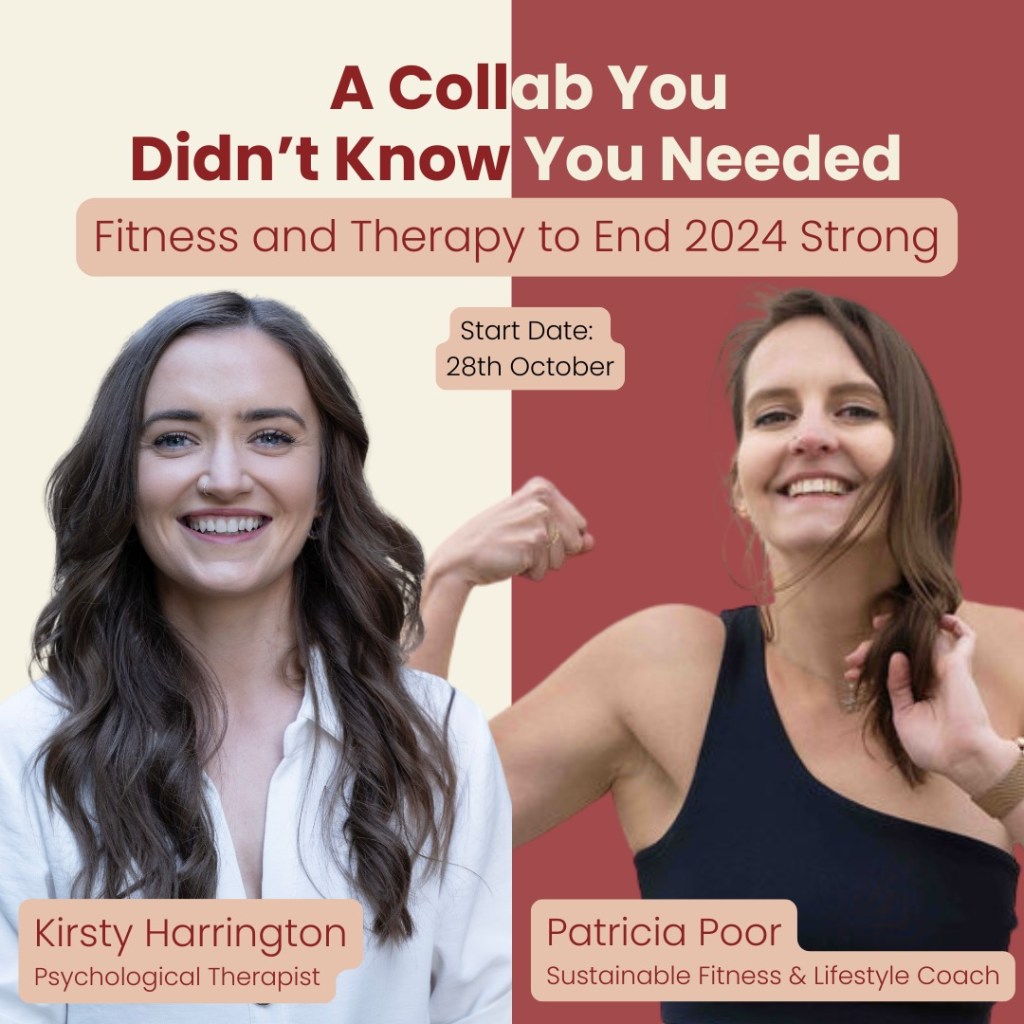
If you follow me on LinkedIn, you might have already seen this exciting news – Fitness Coach Patricia Poor and I are bringing together our expertise in psychotherapy and fitness to help you end 2024 strong, in your mind and in your body 🧠 💪
We know that these coming weeks can be challenging – the cold and dark nights that impact moods and routines, the stress that builds as we move into holiday season.
Rather than just getting through to the end of year, what if you could feel at your best? 💫
We have designed this program to help you:
💪 Confidently create consistency 🧠 Manage holiday stress ⚖️ Cultivate balance in the mind and body ✨ Break free from all-or-nothing thoughts and behaviours
We only have 4 spaces available for this program as we believe in giving you our best effort, time, and attention so we can help you end this year strong.
💥 The full 6-week program – 6 therapy sessions + personalised workouts + fitness coaching – is just £599 💥
🐣 And if you sign up before October 21st, you’ll get a bonus call with me and Pat.
Let’s finish 2024 together 💫
Send me an email for information and to get started!
I couldn’t be more thrilled to be able to share this testimonial. This client provided her feedback with consent for it to be publicly shared. If you would like to begin working with me, drop me an email to get started.
“I started working with Kirsty at the end of 2022. I had moved abroad but it hadn’t worked out, and I was under a lot of pressure from people close to me to “figure out what I was doing with my life”, which led to me having panic attacks and high levels of anxiety that I’d previously had completely under control.
I tried a few therapists before Kirsty, two that I just did a single session with but one who I saw for a twelve-week block, but I found it frustrating, grounded too much in the past and I felt like words were being put in my mouth.
Kirsty’s approach was a complete breath of fresh air.
I feel heard and understood in every session, and she doesn’t tell me what to do or how I’m feeling, instead guiding me towards making decisions for myself and highlighting things I’ve said by repeating them back to me and prompting me to think about why I’ve said that.
The reason why I’ve loved working with Kirsty is because she is very focussed on the future. We’ve jumped back in time in the early days and spoken about the root causes behind my anxiety, but all with the objective of moving forwards and making progress in my life now.
Once my anxiety was more under control, we moved to a session every two weeks and now have ad hoc sessions if I have a challenging situation to deal with or I just feel like clearing my head. Kirsty creates a safe space to talk, and I always leave her sessions feeling better equipped to deal with whatever comes my way.
We can have a lot of light-hearted moments in our sessions, and she is very easy to get along with and relate to, which I think helped build a relationship of trust very quickly.
Kirsty’s sessions don’t feel clinical, but instead warm, like you’re getting advice from an older sister rather than sitting in a therapist’s office.
I look forward to our sessions and even when I’m in a good place with my anxiety issues, Kirsty has helped me with relationships, travel, my career and supported me as I moved to another different country (but I’ve been here for 10 months now, so this time it’s working out!)
I couldn’t recommend her more.
She’s supported me in turning my whole life around and has helped me regain my confidence and self-esteem. I continue to work with her because I think her sessions make me more self-aware, compassionate and confident, and she is helping me to understand and empathise with myself in a way I never could before, which has led to me being a happier person.”
If you want to become more self-aware, compassionate, confident, and happier like this client, drop me an email to get started.
Clarity, confidence, and tools for whatever life throws at me
I had the absolute pleasure of working with this client*, getting to know her over the course of our sessions, and witnessing a deep level of self-awareness and progression.
I’m filled with gratitude to be able to share how she found working with me:
“I’m so grateful for the support and guidance I received from Kirsty.
Her ability to truly listen and understand my concerns was invaluable. She helped me delve deep into the root of my problems, providing a safe and non-judgmental space for me to explore my thoughts and feelings.
Thanks to her expertise and compassionate approach, I feel empowered and equipped to move forward with greater clarity and confidence.
She gave me lots of tools for the life toolbox and techniques to use if I ever find myself in that place again to able successfully navigate the future with confidence, whatever life throws at me.”
If you would like to gain tools and gain clarity and confidence, please get in touch with me to get started.
*This client provided this feedback knowing that it would be publicly shared.
Anxiety is unpleasant and distressing with symptoms including:
Feeling light-headed
Feeling nauseous
Sweaty face, armpits, and palms
Knot in the stomach
Racing heart
Tight chest
Anxiety comes along when the amygdala (a small almond-shaped part of the brain) interprets a “threat” and begins preparing the mind and body for “fight-or-flight” in order to survive.
We need this system to function so that we can keep ourselves safe if there is an emergency.
However, in modern-day living, this system gets activated in non-life-threatening situations when we get anxious about daily life, so our fight-flight reaction is kicking in when it’s not really needed.
The issue is that when this reaction kicks in, the behavioural elements of fight or flight can become problematic for our work, relationships, and lifestyle.
The consequences of “flight”
Flight is when we escape the situation, we leave, we don’t turn up, we don’t face the problem. The amygdala threat alarm rings, the brain goes “get me out of here!”, and we flee.
This is an understandable reaction because the brain is interpreting the situation as threatening and is doing what it can in that moment to return you to “safety”.
So, we can say that, very short-term, avoidance works for dealing with anxiety.
But this isn’t the whole picture because as adults in modern day, that situation we avoided hasn’t gone away or been resolved; the problem is still there waiting to be dealt with.
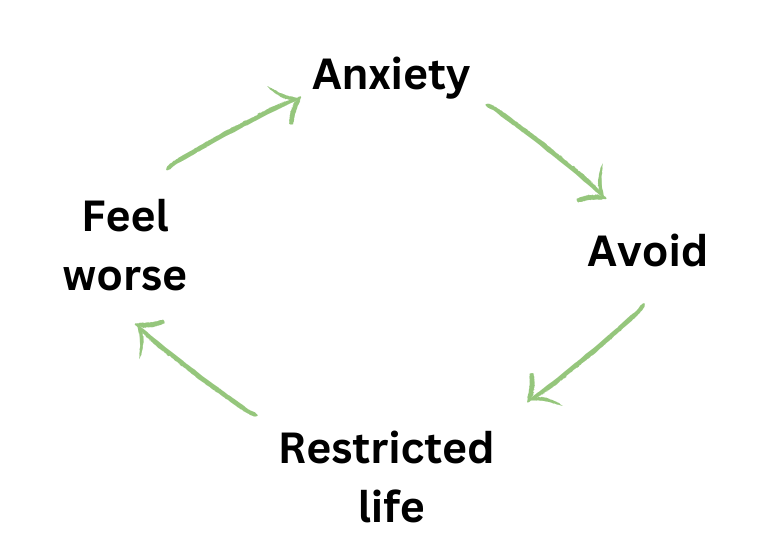
We can sum up the problem with avoidance in the image below:
This is a vicious cycle.
Over the longer-term, as we go round and round this vicious cycle, we’re restricting our life, becoming more anxious, confidence is dipping, and our comfort zone becomes smaller and smaller while our anxiety increases and confidence falls.
What a pickle!
Know that it doesn’t need to be this way.
The first step is awareness. Become aware of what situations you’re avoiding and become aware of what you think about the situation. Common anxious thoughts relate to the problem being too big, you don’t know how to solve it or cope, you’re all alone and nobody else will help you.
Secondly, begin to talk back to those thoughts to give yourself some reassurance and encouragement. Remind yourself that things often aren’t as bad as the anxiety leads us to believe, that you can do it even if you need to break problems down into smaller manageable chunks or ask for help.
Thirdly, rip the band-aid! Ok, I know this is scary but biting the bullet is short-term “pain” for long-term gain. You can do this.
Top tip – remember to slow down and breathe to help regulate your nervous system as you take these steps.
If this feels too overwhelming to go alone, I’d be happy to help you. We can work out what the problems are, reframe unhelpful thoughts and beliefs, and create manageable steps to get you back out there with confidence.
I offer one-one therapy online and face-face in Edinburgh.
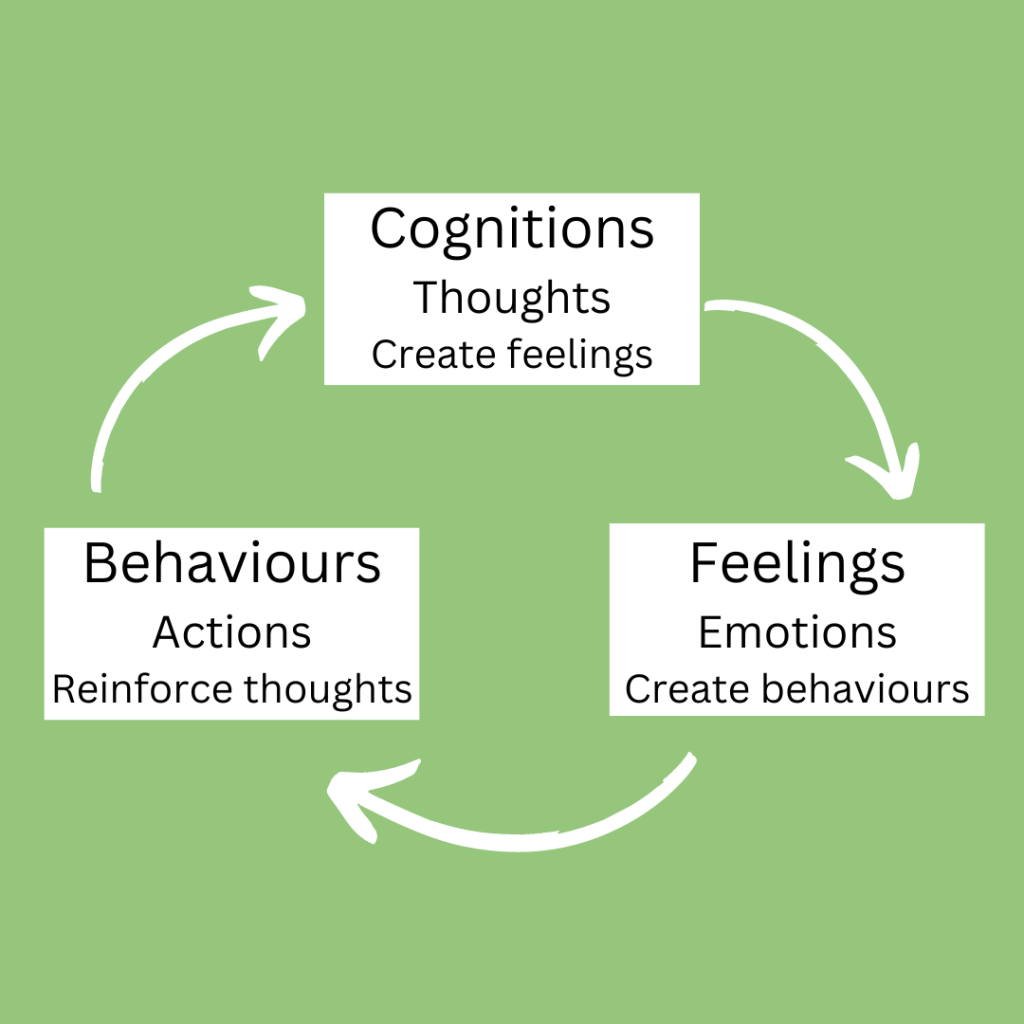
CBT – Cognitive Behaviour Therapy – is a highly effective form of therapy that focuses on the link between what we think, what we do, and how we feel as shown in the diagram below:
Our thoughts influence our feelings, our feelings inform our behaviour, and our behaviour can reinforce our thoughts and beliefs. As such, we can find ourselves in “vicious cycles” of unhelpful thoughts, uncomfortable or distressing feelings, and unhelpful behaviours that keep us stuck in the cycle.
Note that I’m saying unhelpful thoughts and behaviours. In therapy, it’s important to step back from judgement as this creates a barrier to effective change. Rather than criticise ourselves as being wrong, silly, or stupid, we can simply notice that what we’re thinking and doing is unhelpful for the outcome we’re seeking.
CBT aims to help the client develop self-awareness and tools to be more present in daily situations and to be able to identify and adjust unhelpful thoughts and behaviours in order to feel better.
CBT is evidence-based and recommended by NICE guidelines (National Institute of Clinical Excellence) which is the government standards and recommendations for the best practice of health and care treatments and technologies.
What to expect
CBT sessions tend to last 50 minutes and take place on a weekly basis.
The sessions are quite structured with an agenda set at the beginning of each session so that both client and therapist know what will be worked on. The therapist will typically lead on this in the beginning sessions as the client becomes familiar with therapy but there is always scope for the client to add items to the agenda, perhaps particular situations that have been on the client’s mind that week.
CBT is usually more time-limited than other forms of therapy – typically 6-20 sessions – to work on a specific problem. For example, if you have a problem with anxiety in social situations, the first few sessions are about understanding what happens for you in social settings in terms of your thoughts, feelings, and behaviours and considering where this problem has originated from. The next few sessions might work on adjusting your thoughts and testing new behaviours. The remaining sessions are used to create a plan to maintain your progress before moving towards an end.
CBT involves out-of-session work which may involve things like reading over some information, reflecting on your experience, practicing CBT tools and models, or trying out new ways of doing things. The purpose of this is to build forward momentum for the change you’re working on and create new pathways in your brain to turn these new strategies into habits.
We’re only together for 50 minutes each week, do you think that alone is enough to change your life? Like with most things, you’ll get out what you put in! If you’re struggling to do the agreed work, let your therapist know so a solution can be found.
CBT with me
I am calm, friendly, and organised and I make it my mission to help clients make meaningful, sustainable change. As my client, I want you to understand yourself more fully, to get to the root of the problem, and to feel empowered to make choices and decisions.
I encourage you to turn up as yourself – no need to worry about getting things right or wrong, or oversharing, or swearing. The time and space we have together is safe for you to say what needs said and I’ll be here to guide you forward.
I’m big on holistic health so I’ll likely check in with your hydration, nutrition, exercise, sleep, and caffeine consumption as these factors all interlink with our mental health and wellbeing.
Language is also a key point of interest for me – language says a lot about the meaning we give to ourselves, other people, and the world. Don’t be surprised if I ask you what you mean by certain things or pick up on words, phrases, or images – I’m not quizzing you, I’m genuinely keen to hear more about your perspective!
My biggest aim is for you to feel better within yourself and about yourself, I’m here for you.
If you work with me through an insurance provider, we’ll have allocated session numbers to help you work on resolving a particular problem. I’ll draw out a research-based treatment plan and we’ll work methodically towards reaching your hopes within our timeframe.
If you work privately with me, sessions can be a little more flexible if needed, and you may wish to continue seeing me over a longer period of time. This can be for various reasons – perhaps a life event occurs that you’d like some support navigating; perhaps you’d benefit from regular accountability, or perhaps you like knowing you have someone impartial to speak to.
Ways to work with me
I provide online therapy sessions via Zoom on Mondays, Wednesdays, and Thursdays.
I provide face-face therapy sessions in Edinburgh on Tuesdays.
How to get started
Drop me an email with your name, your preference for remote or face-face sessions, and your availability and we can arrange an initial call to get started!
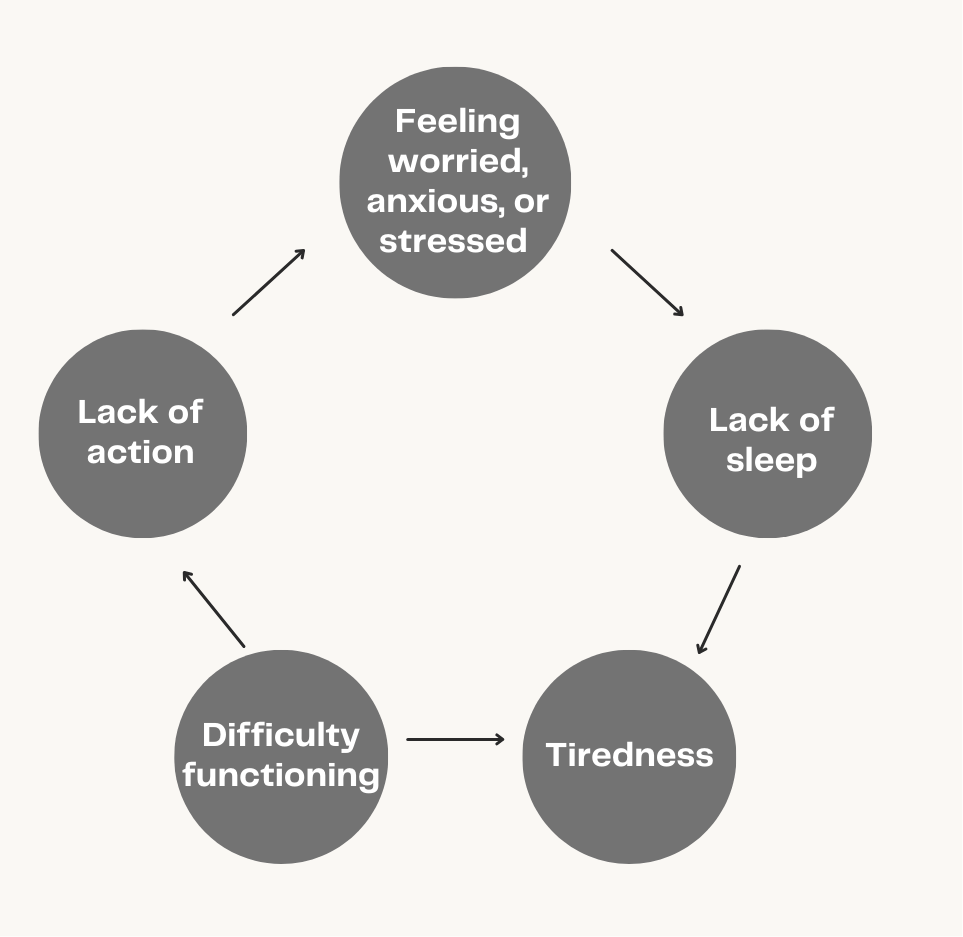
Sleep and mental health have a reciprocal relationship; our mental health can impact our sleep quality and poor sleep can impact our mental health and wellbeing as illustrated in the vicious cycle below:
Read on for my Top Ten Tips for improving your chances of a better sleep!
Environment Make your room somewhere you want to relax and sleep.
Do this by tidying your room and keeping the bedroom for sleep and sex only. Avoid eating, drinking, or watching tv in your sleep space.
Routine Try to stick to a bedtime and a wake time and avoid snoozing through the day.
This can feel tricky but sticking with it can help regulate your circadian rhythm meaning your mind and body are programmed for sleep.
Caffeine and sugar Avoid caffeine or high sugar food or drinks prior to bed.
Usual caffeine suspects are coffee, tea, energy drinks, and chocolate. I’m not necessarily asking you to give them up forever, just while we’re sorting your sleep out!
Swap the screens Reduce or avoid screen time where possible before bed. The blue lights from the screens keep our brains awake and sometimes the content puts our brains on high alert, particularly watching the news or high action movies.
Pick up a book instead – our eyes moving left to right across the page helps induce sleep.
Too many to-dos or should-have-dones? Write down those thoughts that swim round and round in your mind.
Getting them out of your mind and onto the page means that you can go to sleep safe in the knowledge that your thoughts won’t be forgotten.
2-4 Breathing Inhale for the count of 2, and exhale for the count of 4. Extending the exhale relaxes the mind and body, taking our nervous system to the “rest and digest” state.
It’s normal for the mind to wander off, return your focus to your breath.
Avoid the countdown “If I fall asleep now I’ll get 7 hours… oh no, now I’ll only get 6 hours…”
Instead remind yourself that sleep is a fundamental need of the body, you will manage to sleep, and even simply resting the body, mind, and eyes is worthwhile.
Block out the light Eye masks can be helpful for blocking out light and signalling to the brain that it’s time to sleep – no more staring at the ceiling!
Eye masks are inexpensive and come in a range of colours and materials so you can find what works for you.
Relaxing sounds Listening to ocean sounds, forest sounds, rain drops, or guided sleep meditations can be a helpful distraction if thoughts are still circulating in your mind.
There’s loads to choose from on youtube, so if one doesn’t work either try it again or try a different audio.
Natural remedies Drinking “Sleepy Tea” or “Night Time Tea” can be helpful as they typically contain ingredients like lavender and camomile which promote a calm state.
Avoid drinking too close to bed time as you’ll likely be up through the night for the toilet! I’d recommend at least an hour prior to bed.
There you have it! Have a go at incorporating these tips into your routine for a couple of weeks to see how it impacts your sleep ability and quality and let me know how you get on.
If you’re struggling to establish a sleep routine or those pesky racing thoughts stick around, I could help you in 1-1 therapy by processing your stress, worry, or anxiety and tailoring the information specifically to you and your circumstances. Drop me an email to get started.
Take a deep breath. We’ve all heard that, right? Perhaps before a job interview, a driving test, or when feeling angry or upset. But does breathing really make a difference?
James Nestor certainly thinks so, and he shares his experience and perspective in his compelling book, “Breath – The new science of a lost art” in which he discovers that by making slight changes to our breathing we can:
Jump-start athletic performance
Rejuvenate internal organs
Halt snoring, allergies, asthma, and auto immune disease
Straighten scoliotic spines
With such big claims being made, there’s been a lot of hype in the health and wellness space about this book, so I grabbed myself a copy to see what all the fuss was about.
Read on to find out if you should follow the crowd too!
In this review of Breath by James Nestor, I’m bringing you:
Intro to the author and the book
My key takeaways
How breathing relates to your mental health
Should you read it
Breath, James Nestor
James Nestor is a science journalist, a role which involves conveying science to the masses. If you understand the climate crisis, AI developments, or Covid19, that’s likely thanks to people like James Nestor translating all the science jargon.
A doctor-recommended breathing class transformed Nestor from being emotionally and physically ill to calm, quiet, and rested. He becomes driven to know what happened to him in that class and how, and so begins Breath.
The book is split into 3 parts that take us back through time and across the world as Nestor rediscovers various breathing techniques with the help of breath pioneers who he calls”pulmonauts”:
Part One – The experiment
Part Two – The lost art and science of breathing
Part Three – Breathing+
Nestor includes an ample Appendix full of breathing techniques for the reader to try out and he sign posts his website for video tutorials too.
My key takeaways
I was struck by how many common conditions and problems breathing is connected to:
ADHD, anxiety, and depression
Asthma, allergies, blood pressure issue, and COPD
Bronchitis, lung capacity issues, and pneumonia
Headaches, migraines, and scoliosis
Insomnia, sleep apnoea, and snoring
Being overweight, having skin conditions, and sexual dysfunction
Excessive thirst and peeing in the night
“Our ability to breathe full breaths was literally a measure of living capacity”
Contrary to popular belief, lung capacity out-ranks genetics, diet, and exercise as the greatest predictor of life span. Thankfully, we aren’t doomed by our current lung capacity as internal organs are malleable, meaning that we can work on our lung capacity at any age.
A simple takeaway – but one that really landed with me – was to close your mouth when you breathe. I won’t say too much on this as it’s the focus of “the experiment” in Part One of the book; Nestor compels the reader to make this simple change by detailing his gruelling breathing experiments.
My biggest takeaway from is an increased awareness of my own breath – whether my breath is reaching my belly or getting stuck in my chest; if I’m sleeping with my mouth closed; if I can continue to breathe through my nose while exercising. This awareness now naturally flows to a self-scan in which I notice how I’m feeling, if I’m holding any tension anywhere, if anything needs tended to. In short, it’s increased my ability to self-regulate.
Breathing for your mental health
One of the key links between breath and mental health is the body’s control system – the autonomic nervous system – containing two opposing nervous systems – the parasympathetic and the sympathetic.
The parasympathetic nervous system is responsible for the rest and relax state and is sometimes called the “feed and breed” or “rest and digest” system.
On the other hand, when we’re feeling stressed or anxious, the sympathetic nervous system kicks into action, you might have heard of this as the “fight or flight” response. This system makes us alert and “meaner and leaner” so we can deal with danger.
We activate these systems when we breathe. Inhaling activates the alert sympathetic system; exhaling takes us to the relaxed parasympathetic system. Extending the exhale longer than the inhale helps take us to a relaxed state, an example of this being to inhale for the count of 2 and exhale for the count of 4. Personally, I find this technique helpful for falling asleep.
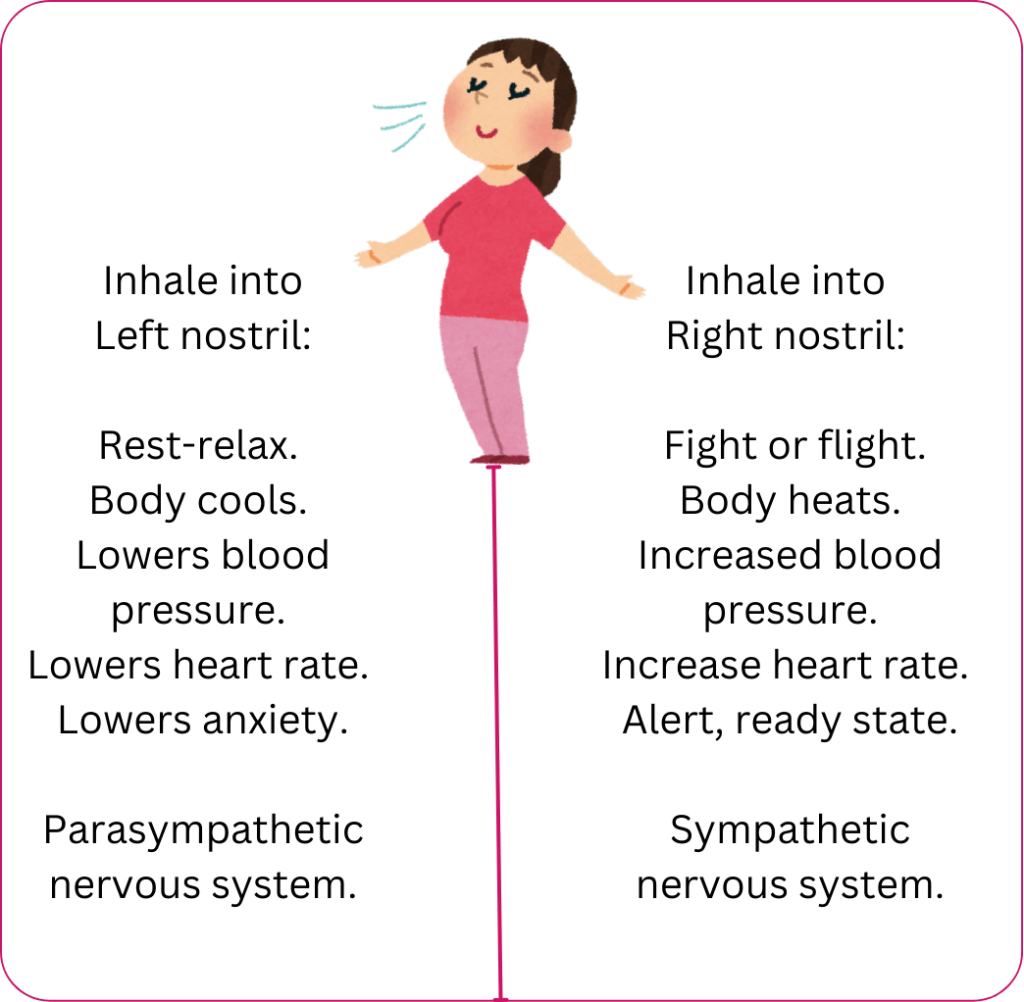
Nestor provides an overview of how breathing interacts with the two systems which I’ve outlined here:
A breathing technique that enables inhaling into each nostril is “alternate nostril breathing” (aka nadi shodana) which can be found in Nestor’s Appendix. This technique involves using the thumb and ring finger to hold and release nostrils to control air flow and is particularly helpful for reducing stress for example prior to a meeting, an event, or sleep.
Breathing techniques could be a key tool for managing psychological issues including ADHD, anxiety, depression, insomnia, and panic as we can develop control over which state we activate and when.
The important thing to remember with any breathing technique is to keep practicing! Often I hear people say “I tried a breathing exercise once but it didn’t work” or “I was too distracted”. Even though we breathe all the time, these techniques are a new skill that will require time, effort, and practice. If (and when) distraction sneaks in, gently guide the mind back to focusing on the breath.
Should you read it
This is an interesting read that goes back through history and across cultures to bring “forgotten” knowledge of the breath to a new audience and in the process brings self-awareness and breathing techniques to the reader.
My main critique is that the title suggests that Nestor is bringing us “new science” about the breath, but what we get is mainly anecdotes and personal experiments from an excellent storyteller.
I’d recommend this book if you’re struggling with any of the physical or psychological health issues mentioned throughout this review and want to try some of the techniques to support your health and wellbeing, or you want to improve your lung capacity to increase your life span.
I am absolutely delighted to share this recent testimonial from a client who went from a place of sadness to decision, growth, and living more fully through therapy:
“I came to Kirsty feeling sad about my life and my choices, and I was still coming to terms with aspects of my childhood and my parents (continuing) unhelpful behaviour to me.
I wanted things to be and feel different and approach my career and life with more confidence.
Kirsty has helped feel more myself and decisive about my choices. She always listened carefully and in our session gave me a space to look carefully at my own behaviours and those around, to find a better way to think and live and to work towards my ambitions.
Sometimes Kirsty would send me appropriate links to articles or other information that was pertinent to our session. I found this meant I could think and read more deeply about the issues in between sessions. I made notes throughout our sessions and return to these notes as I continue to grow and live my life more fully.”
If you would like regular time and space in your week to consider your own needs, priorities, thought patterns, and behaviours, find new ways of doing things, and feel more confident, I’m here for you.
 Therapy with Kirsty