How do you review something so layered, so insightful, so expertly created?
These are the questions I’m asking myself as I sit down to write this review of “Maybe you should talk to someone” by American psychotherapist Lori Gottlieb.
In this instant New York Times bestseller, Gottlieb tells her story of being a therapist, whilst also attending therapy as a client herself, the very same position I was in when my good friend gifted me this book.
Gottlieb begins by posing the question, “how do we change?” and through the pages of her book she responds, “in relation to others”. The therapeutic process is brought to life by Gottlieb sharing her clients’ stories, her own perspective of sessions and clients, and how she finds relating to her own therapist, Wendell. The latter of which she captures brilliantly in her line, “I both loved and hated Wendell for saying that”.
The strength and depth of the therapeutic relationship is the basis for effective work. But just like any other relationship, it can be complicated. It’s the process of turning up, sitting in discomfort, and doing the work from both client and therapist that creates safety for exploring and creating change.
This book is an expertly crafted interweaving of stories that exemplify the therapeutic arc taking us from what’s bringing clients to therapy now, laying it all out, editing the narrative, moving towards meaningful change, and coming to an end.
Gottlieb introduces us to four of her clients:
- A twenty-something who is into bad guys and booze
- A thirty-year-old newlywed with a terminal illness
- A forty’s TV producer who calls everyone else an idiot
- A 69-year-old contemplating suicide if things don’t get better
Through these tales we sit in ambivalence with the twenty’s client, face death with the thirty’s, learn about defence mechanisms with the forty’s, and seek forgiveness with the almost-septuagenarian. The craftsmanship of the writing absorbs you in each client making it easy to follow each client’s journey.
Just like therapy, as the stories unfold and we delve into the depths of learning with Gottlieb and her clients, there’s a somewhat sudden, yet also subtle, shift as the pace picks up as they all move through their change process, pictured below:
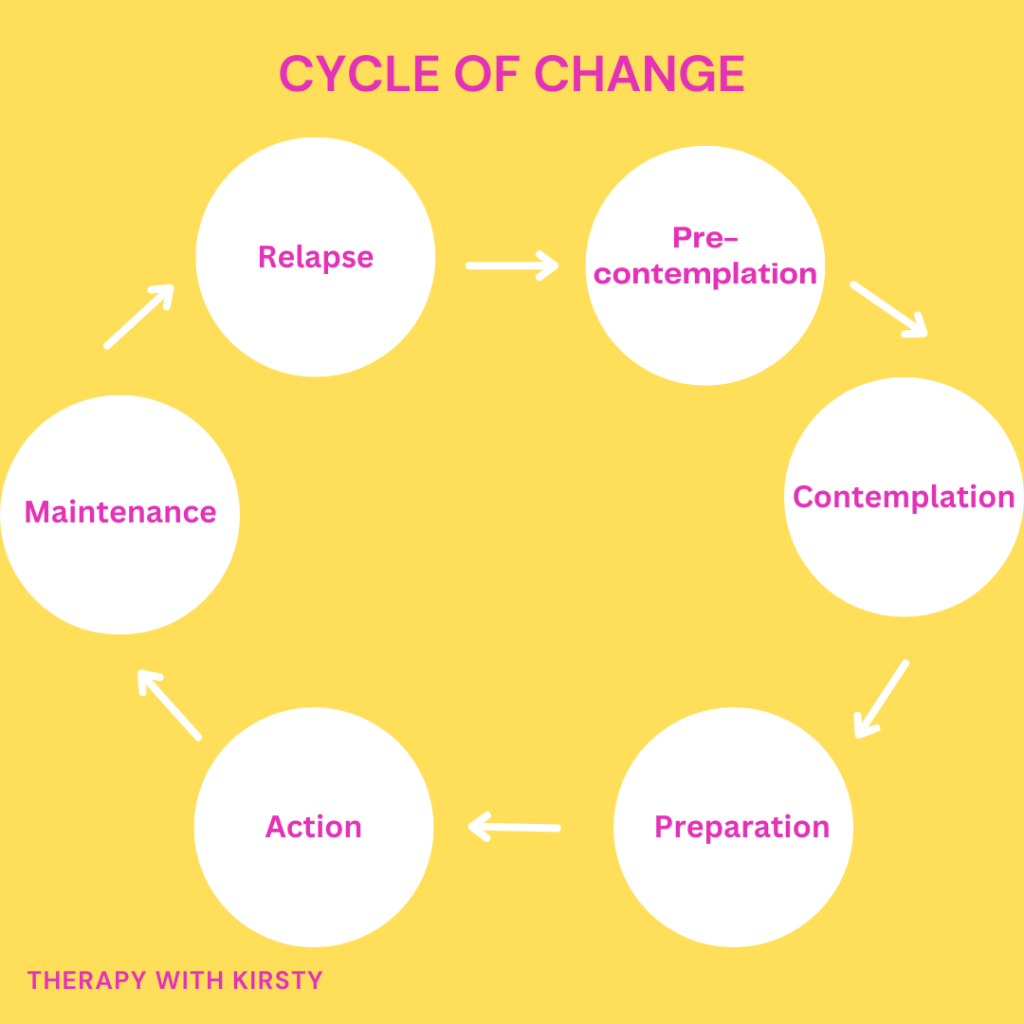
Gottlieb describes this change process as happening “gradually and then all at once”.
This book is one to be highlighted and scribbled on as Gottlieb brings an abundance of knowledge to every page.
You’ll find out about:
- Erikson’s psychosocial changes
- Four ultimate concerns
- Misery-seduction dynamic
- Privacy vs. secrecy
- Projection and projective identification
- Reacting vs. responding
- Ultracrepidarianism
- Unconditional positive regard
- And much, much more!
It’s not just the psychological context but also Gottlieb’s graceful articulation of tender moments of therapy that you’ll want to underline. A standout line for me was: “I watch her hear what she already knows” which for me called to mind so many of my wonderful clients, particular moments where we’ve sat in the reality of it all, where I’ve seen emotions appear before my eyes, where I’ve felt a physiological shift in my body and observed the shift in them as we arrive at and embody realisations.
Therapists are somewhat mysterious as our work is bound with confidentiality, meaning that people often struggle to grasp the nature of our day-to-day as we can’t elaborate or exemplify what we do. By bringing the four clients plus herself as a fifth client, Gottlieb provides a real insight into how clients present and how therapists work in session, and how therapists are in Gottlieb’s words, “a card-carrying member of the human race” which is not a flaw, it’s our biggest credential.
Gottlieb captures the sense of mystery when she addresses the question that we therapists often get asked “what kind of people do you see in your practice”, to which she responds, “just like any of us, which is to say, just like whoever is asking”.
You don’t need to be in crisis, you don’t need to have a diagnosis, therapy is for any of us.
Throughout writing this review, I caught myself being tempted to refer to the author as “Lori”. This speaks to the familiarity she creates through her writing. It feels deeply personal and vulnerable whilst also feeling very considered and expertly crafted. I also struggled to write this review because I didn’t want to say too much that would spoil the story unfolding for you!
I highly recommend this book – whether you’re interested in going to therapy, have already been, are a therapist yourself, you want to learn more about humans, or you just want a damn good read.
Expertly written, this book is an absolute gem that I’m sure I’ll be rereading for years to come.

* Bonus recommendation: If you read the book and enjoy it, I’d also recommend watching Couples Therapy on BBC iPlayer which is a similar behind-the-scenes look at therapy, facilitated by Dr. Orna Guralnik.
 Therapy with Kirsty