What is CBT
CBT – Cognitive Behaviour Therapy – is a highly effective form of therapy that focuses on the link between what we think, what we do, and how we feel as shown in the diagram below:
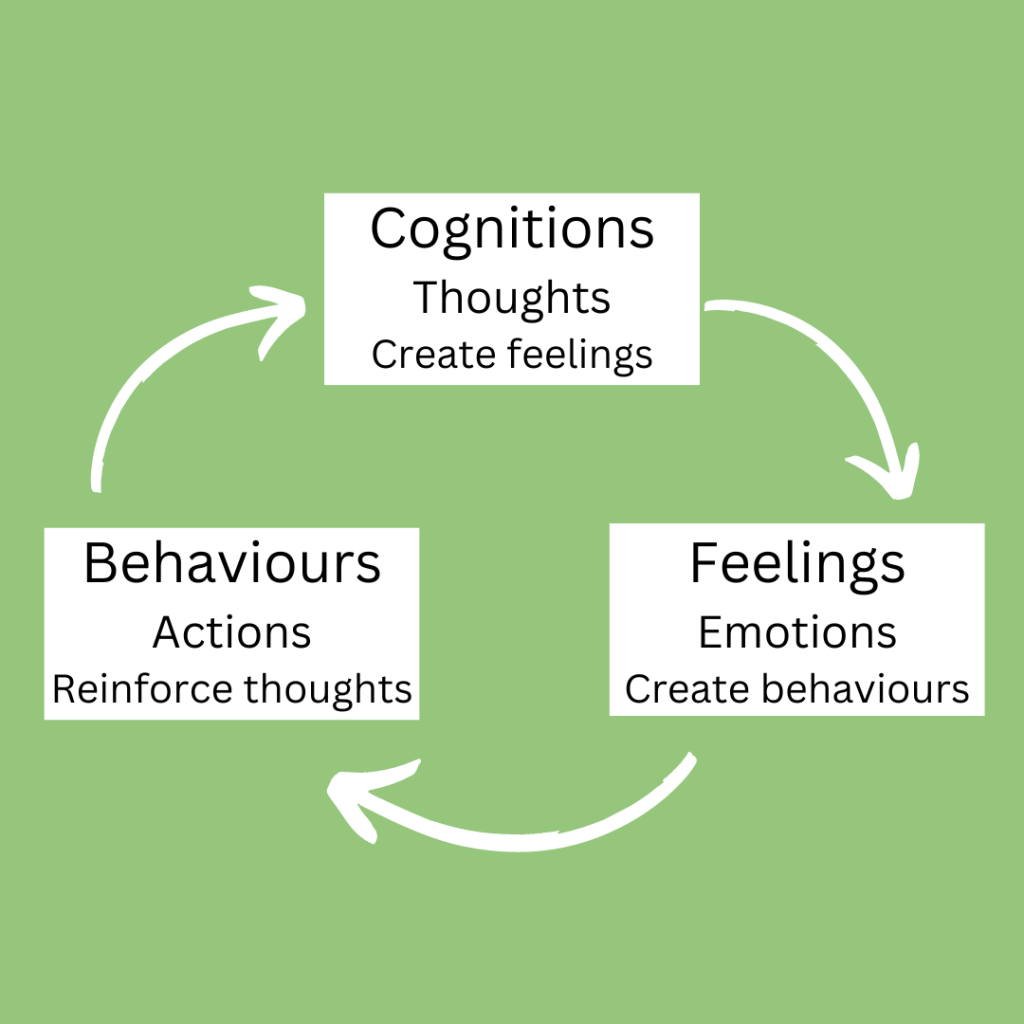
Our thoughts influence our feelings, our feelings inform our behaviour, and our behaviour can reinforce our thoughts and beliefs. As such, we can find ourselves in “vicious cycles” of unhelpful thoughts, uncomfortable or distressing feelings, and unhelpful behaviours that keep us stuck in the cycle.
Note that I’m saying unhelpful thoughts and behaviours. In therapy, it’s important to step back from judgement as this creates a barrier to effective change. Rather than criticise ourselves as being wrong, silly, or stupid, we can simply notice that what we’re thinking and doing is unhelpful for the outcome we’re seeking.
CBT aims to help the client develop self-awareness and tools to be more present in daily situations and to be able to identify and adjust unhelpful thoughts and behaviours in order to feel better.
CBT is evidence-based and recommended by NICE guidelines (National Institute of Clinical Excellence) which is the government standards and recommendations for the best practice of health and care treatments and technologies.
What to expect
CBT sessions tend to last 50 minutes and take place on a weekly basis.
The sessions are quite structured with an agenda set at the beginning of each session so that both client and therapist know what will be worked on. The therapist will typically lead on this in the beginning sessions as the client becomes familiar with therapy but there is always scope for the client to add items to the agenda, perhaps particular situations that have been on the client’s mind that week.
CBT is usually more time-limited than other forms of therapy – typically 6-20 sessions – to work on a specific problem. For example, if you have a problem with anxiety in social situations, the first few sessions are about understanding what happens for you in social settings in terms of your thoughts, feelings, and behaviours and considering where this problem has originated from. The next few sessions might work on adjusting your thoughts and testing new behaviours. The remaining sessions are used to create a plan to maintain your progress before moving towards an end.
CBT involves out-of-session work which may involve things like reading over some information, reflecting on your experience, practicing CBT tools and models, or trying out new ways of doing things. The purpose of this is to build forward momentum for the change you’re working on and create new pathways in your brain to turn these new strategies into habits.
We’re only together for 50 minutes each week, do you think that alone is enough to change your life? Like with most things, you’ll get out what you put in! If you’re struggling to do the agreed work, let your therapist know so a solution can be found.
CBT with me
I am calm, friendly, and organised and I make it my mission to help clients make meaningful, sustainable change. As my client, I want you to understand yourself more fully, to get to the root of the problem, and to feel empowered to make choices and decisions.
I encourage you to turn up as yourself – no need to worry about getting things right or wrong, or oversharing, or swearing. The time and space we have together is safe for you to say what needs said and I’ll be here to guide you forward.
I’m big on holistic health so I’ll likely check in with your hydration, nutrition, exercise, sleep, and caffeine consumption as these factors all interlink with our mental health and wellbeing.
Language is also a key point of interest for me – language says a lot about the meaning we give to ourselves, other people, and the world. Don’t be surprised if I ask you what you mean by certain things or pick up on words, phrases, or images – I’m not quizzing you, I’m genuinely keen to hear more about your perspective!
My biggest aim is for you to feel better within yourself and about yourself, I’m here for you.
If you work with me through an insurance provider, we’ll have allocated session numbers to help you work on resolving a particular problem. I’ll draw out a research-based treatment plan and we’ll work methodically towards reaching your hopes within our timeframe.
If you work privately with me, sessions can be a little more flexible if needed, and you may wish to continue seeing me over a longer period of time. This can be for various reasons – perhaps a life event occurs that you’d like some support navigating; perhaps you’d benefit from regular accountability, or perhaps you like knowing you have someone impartial to speak to.
Ways to work with me
- I provide online therapy sessions via Zoom on Mondays, Wednesdays, and Thursdays.
- I provide face-face therapy sessions in Edinburgh on Tuesdays.
How to get started
Drop me an email with your name, your preference for remote or face-face sessions, and your availability and we can arrange an initial call to get started!
 Therapy with Kirsty